
Head to head
Split vs Statsig
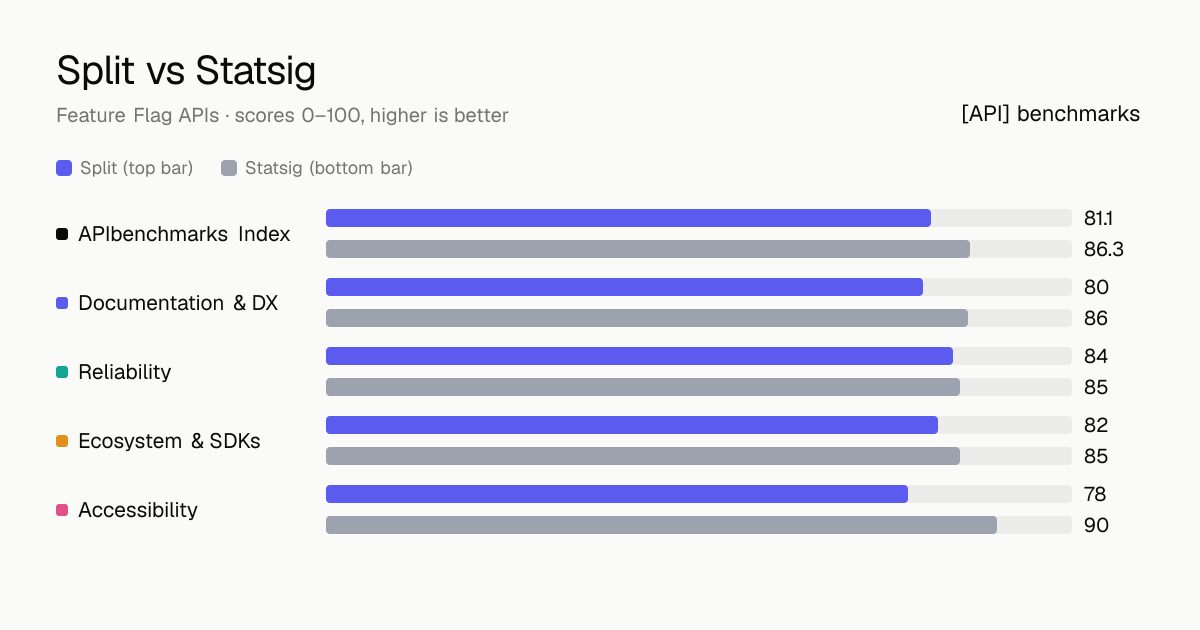
As a feature flag API, Statsig rates higher on the APIbenchmarks Index, 86.3 to 81.1, a 5.2-point gap. Here is how they compare on each criterion.
Criterion by criterion
| Criterion | Split | Statsig |
|---|---|---|
| Documentation & DX | ||
| Reliability | ||
| Ecosystem & SDKs | ||
| Accessibility | ||
| APIbenchmarks Index | 81.1 | 86.3 |
Specifications
| Split | Statsig | |
|---|---|---|
| Best for | Feature management + experimentation (Harness FME) | Flags + experimentation + product analytics |
| Free tier | Free Developer tier: up to 10 seats, 50 feature flags | Free: unlimited flag checks + 2M metered events/mo, up to ~1M MTUs |
| Pricing | Per-seat (usage-based at scale) | Per metered event / MTU-based |
| Official SDKs | 12 languages | 12 languages |
Is Split better than Statsig?
On the APIbenchmarks Index, Statsig rates higher (86.3 vs 81.1). It leads on the four weighted criteria, but price is reported separately, so the best choice still depends on your budget.
Verdict in one line
Statsig leads by 5.2 points (86.3 vs 81.1) and wins 4 of 4 criteria.
Winner by criterion
| Criterion | Winner | ||
|---|---|---|---|
| Documentation & DX | 80 | 86 | |
| Reliability | 84 | 85 | |
| Ecosystem & SDKs | 82 | 85 | |
| Accessibility | 78 | 90 |
Choose Split if… / choose Statsig if…
- →your use case matches its focus: feature management + experimentation (harness fme)
- →documentation & dx matters most to you (86 vs 80)
- →reliability matters most to you (85 vs 84)
- →ecosystem & sdks matters most to you (85 vs 82)
- →accessibility matters most to you (90 vs 78)
- →your use case matches its focus: flags + experimentation + product analytics
Pricing side by side
- Model
- Per-seat (usage-based at scale)
- Free tier
- Free Developer tier: up to 10 seats, 50 feature flags
- Free / Developer$0
- Team (Starter)from $33 / seat / month
- Business / GrowthCustom (contact sales)
- EnterpriseCustom (contact sales)
- Model
- Per metered event / MTU-based
- Free tier
- Free: unlimited flag checks + 2M metered events/mo, up to ~1M MTUs
- Developer (Free)$0/month
- Pro$150/month
- EnterpriseCustom
Vendor-published pricing, verified 2026-06-27 (Split) and 2026-06-27 (Statsig).
SDK and language coverage
Both · 6
JavaScript (Node.js & Browser)PythonRubyGoPHP (and PHP Thin Client)React / React Native
Only Split · 6
Java.NET / C#AndroidiOSFlutterAngular & Redux utilities
Only Statsig · 6
Next.jsAngularNode.js (server)Java / KotlinRust.NET (client & server)
Strengths and weaknesses
- +Experimentation is first-class: rolling out a flag automatically attributes it to business/operational metrics with statistical significance testing
- +Local, in-memory SDK evaluation backed by Fastly CDN + streaming means sub-millisecond treatment evaluation and millisecond flag propagation
- +Strong, granular customer segmentation/targeting ("splits") on user attributes
- –Premium pricing, generally more expensive than LaunchDarkly, with metered "traffic keys"/MTUs that make scaling costs hard to predict
- –Pricing is opaque: Growth/Enterprise require contacting sales, and most advanced features (data export, SSO, audit logs) are gated to Enterprise
- –Weaker native CI/CD pipeline integration than competitors; some connections need custom webhooks or Zapier
- +Feature-flag and dynamic-config checks are unlimited and free on every tier, you never pay per flag evaluation
- +No per-seat pricing: adding engineers or PMs doesn't change the bill
- +Generous free Developer tier (2M events, unlimited flag checks, 50k session replays, 1-yr retention)
- –Event-/experiment-based metered pricing can produce large surprise bills at high traffic once analytics, experiments or session replay are heavily used
- –No self-hosted / on-prem option, a blocker for strict data-sovereignty requirements
- –Proprietary statistical models are a 'black box', making it hard for data-science teams to validate p-value calculations or run custom frameworks
Split vs Statsig: questions
- Which has better documentation, Split or Statsig?
- Statsig scores higher on documentation and developer experience: 86 vs 80 out of 100.
- Which is more reliable, Split or Statsig?
- Statsig scores higher on reliability: 85 vs 84 out of 100.
- Do Split and Statsig have a free tier?
- Split: yes (Free Developer tier: up to 10 seats, 50 feature flags). Statsig: yes (Free: unlimited flag checks + 2M metered events/mo, up to ~1M MTUs).
- How are Split and Statsig priced?
- Split: Per-seat (usage-based at scale). Statsig: Per metered event / MTU-based.
- Which has more official SDKs?
- Both list 12 official SDKs.