
Head to head
Apollo.io vs Clay
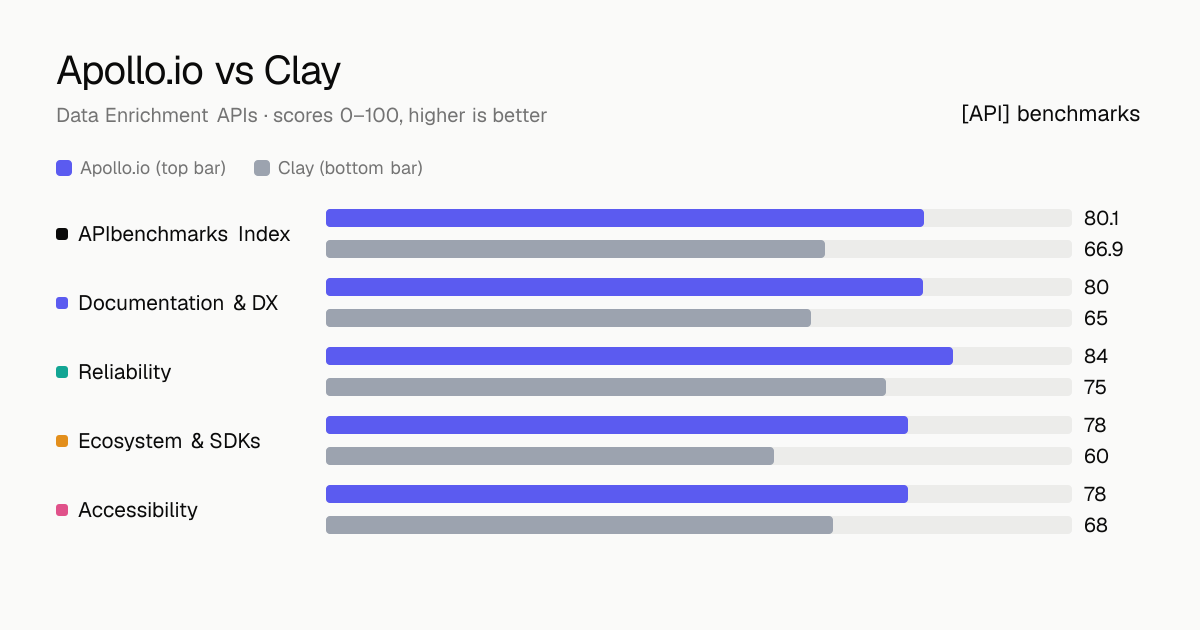
As a data enrichment API, Apollo.io rates higher on the APIbenchmarks Index, 80.1 to 66.9, a 13.2-point gap. Here is how they compare on each criterion.
Criterion by criterion
| Criterion | Apollo.io | Clay |
|---|---|---|
| Documentation & DX | ||
| Reliability | ||
| Ecosystem & SDKs | ||
| Accessibility | ||
| APIbenchmarks Index | 80.1 | 66.9 |
Specifications
| Apollo.io | Clay | |
|---|---|---|
| Best for | Sales engagement plus enrichment | Multi-provider enrichment orchestration |
| Free tier | 10k credits/mo (verified corporate domain) or 100/mo | Free plan with limited credits (no card) |
| Pricing | Per credit (email 1, phone 8) | Data Credits + Actions |
| Official SDKs | 6 languages | 1 languages |
Is Apollo.io better than Clay?
On the APIbenchmarks Index, Apollo.io rates higher (80.1 vs 66.9). It leads on the four weighted criteria, but price is reported separately, so the best choice still depends on your budget.
Verdict in one line
Apollo.io leads by 13.2 points (80.1 vs 66.9) and wins 4 of 4 criteria.
Winner by criterion
| Criterion | Winner | ||
|---|---|---|---|
| Documentation & DX | 80 | 65 | |
| Reliability | 84 | 75 | |
| Ecosystem & SDKs | 78 | 60 | |
| Accessibility | 78 | 68 |
Choose Apollo.io if… / choose Clay if…
- →documentation & dx matters most to you (80 vs 65)
- →reliability matters most to you (84 vs 75)
- →ecosystem & sdks matters most to you (78 vs 60)
- →accessibility matters most to you (78 vs 68)
- →you need broad SDK coverage (6 official SDKs vs 1)
- →your use case matches its focus: sales engagement plus enrichment
- →your use case matches its focus: multi-provider enrichment orchestration
Pricing side by side
- Model
- Per credit (email 1, phone 8)
- Free tier
- 10k credits/mo (verified corporate domain) or 100/mo
- Free$0
- Basic$49/user/mo (annual)
- Professional$79/user/mo (annual)
- Organization$119/user/mo (annual)
- Overage credits$0.20 / credit
- Model
- Data Credits + Actions
- Free tier
- Free plan with limited credits (no card)
- Free$0/mo
- Launchfrom ~$167–185/mo (annual)
- Growthfrom ~$446–495/mo (annual)
- EnterpriseCustom (annual commitment, ~$30k/yr+ typical)
Vendor-published pricing, verified 2026-06-27 (Apollo.io) and 2026-06-27 (Clay).
SDK and language coverage
Both · 0
None
Only Apollo.io · 6
REST API (HTTPS / JSON)OpenAPI / Swagger specificationApollo MCP serverApollo CLIllms.txt index for AI agentsCommunity-built clients (e.g. Ruby gem EnaiaInc/apollo_io), no official first-party language SDKs
Only Clay · 1
No official client SDK libraries published; integration is via HTTP API node, webhooks, and native CRM connectors
Strengths and weaknesses
- +Large database (275M+ contacts, 73M+ companies) with strong US coverage (~80–88% match accuracy)
- +Aggressive pricing that undercuts ZoomInfo/Lusha-class incumbents for comparable breadth
- +Bulk enrichment endpoints (up to 10 people or companies per call) reduce call volume
- –Data accuracy drops sharply outside the US (~60–73% in EU/APAC/LATAM); stale titles common
- –Phone numbers cost 8 credits each yet user-reported direct-dial accuracy is only ~50–70%
- –Credits expire every billing cycle with no rollover and no refund on unused balance
- +Waterfall enrichment chains 150+ data providers under one subscription, materially raising email/firmographic match rates versus any single source
- +Combines enrichment, AI web research (Claygent), and signal monitoring (funding, hiring, job changes, tech installs) in one platform
- +Spreadsheet-style table UI plus Clay University make complex multi-step enrichment accessible without code
- –Dual credit/action model causes fast, hard-to-predict credit burn; auto-recharge billing reportedly fires without advance warning
- –Steep learning curve, reviewers cite hours in week one and 2–3 weeks before workflows are reliable
- –Phone/mobile number coverage is weak (~30–35% match rate)
Apollo.io vs Clay: questions
- Which has better documentation, Apollo.io or Clay?
- Apollo.io scores higher on documentation and developer experience: 80 vs 65 out of 100.
- Which is more reliable, Apollo.io or Clay?
- Apollo.io scores higher on reliability: 84 vs 75 out of 100.
- Do Apollo.io and Clay have a free tier?
- Apollo.io: yes (10k credits/mo (verified corporate domain) or 100/mo). Clay: yes (Free plan with limited credits (no card)).
- How are Apollo.io and Clay priced?
- Apollo.io: Per credit (email 1, phone 8). Clay: Data Credits + Actions.
- Which has more official SDKs?
- Apollo.io lists 6 official SDKs, Clay lists 1.