
Payments API benchmark 2026: Stripe, Square, Razorpay, Mollie, Braintree, Checkout.com, Adyen
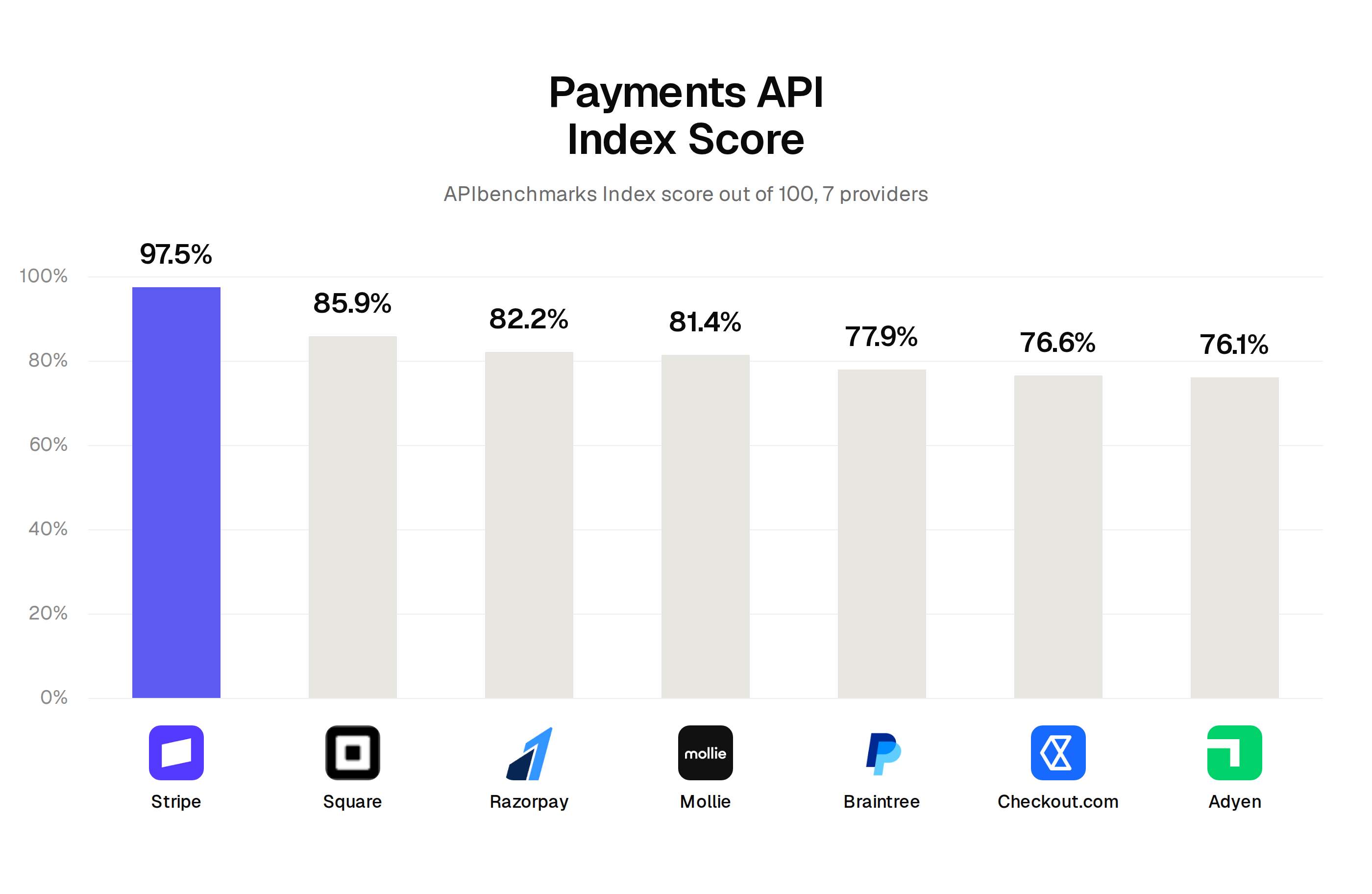
Stripe leads the payments API index at 97.5 (A+), 11.6 points ahead of Square at 85.9. Adyen is last at 76.1, held back by an access score of 38.
Stripe has the highest payments API index score of the seven providers compared, at 97.5 and grade A+. Square is second at 85.9, Razorpay third at 82.2 and Mollie fourth at 81.4. Braintree (77.9), Checkout.com (76.6) and Adyen (76.1) close the table. The gap between first and second is 11.6 points, larger than the 9.8 points that separate Square from last place.
The index scores each API on four things: documentation, reliability, ecosystem and accessibility. Accessibility is where the table splits. Adyen has the second best reliability score at 95 and the lowest accessibility score at 38, so a provider can be strong in production and still hard to start with.
The short version:
- Stripe leads at 97.5 and is first in documentation (98), ecosystem (97), accessibility (98) and reliability (97).
- Square is second at 85.9, 11.6 points behind Stripe. Razorpay, Mollie, Braintree, Checkout.com and Adyen sit within 6.1 points of each other, from 82.2 down to 76.1.
- Accessibility explains most of the bottom of the table. Adyen scores 38, Checkout.com 52 and Braintree 62, against 98 for Stripe.
Which payments API scores highest?
Stripe, with 97.5. It is the only provider in the group with a grade of A+, and it leads all four sub-scores. Square is the only other provider graded A.
| Provider | Index score | Grade | Rank |
|---|---|---|---|
| Stripe | 97.5 | A+ | 1 |
| Square | 85.9 | A | 2 |
| Razorpay | 82.2 | B | 3 |
| Mollie | 81.4 | B | 4 |
| Braintree | 77.9 | B | 5 |
| Checkout.com | 76.6 | B | 6 |
| Adyen | 76.1 | B | 7 |
The top is clear and the middle is tight. Razorpay and Mollie are 0.8 points apart. Braintree, Checkout.com and Adyen are within 1.8 points of each other, so the order of those three could change with a small change in any one sub-score. The 21.4 point distance between Stripe and Adyen is the widest in the table. You can read each provider's full breakdown on the payments category page and the payments verdict.
Which payments API has the best documentation, reliability and ecosystem?
Stripe leads all three. Its documentation score is 98, reliability 97 and ecosystem 97. The runners-up differ by measure.
| Provider | Documentation | Reliability | Ecosystem | Accessibility |
|---|---|---|---|---|
| Stripe | 98 | 97 | 97 | 98 |
| Square | 86 | 86 | 84 | 88 |
| Razorpay | 82 | 80 | 80 | 88 |
| Mollie | 84 | 80 | 76 | 86 |
| Braintree | 80 | 86 | 80 | 62 |
| Checkout.com | 84 | 88 | 76 | 52 |
| Adyen | 84 | 95 | 78 | 38 |
On documentation, Square is second at 86, and Mollie, Checkout.com and Adyen are tied at 84. On reliability, Adyen is second at 95, ahead of Checkout.com at 88 and Square and Braintree at 86. On ecosystem, Square is second at 84, with Razorpay and Braintree at 80.
Two things stand out. Adyen's reliability of 95 is only 2 points below Stripe's 97, the closest any provider gets to Stripe on a sub-score. And Mollie shares the lowest ecosystem score with Checkout.com, both at 76, despite a documentation score of 84.
Which payments API is easiest to start with?
Stripe, at an accessibility score of 98. Square and Razorpay share second place at 88, and Mollie follows at 86.
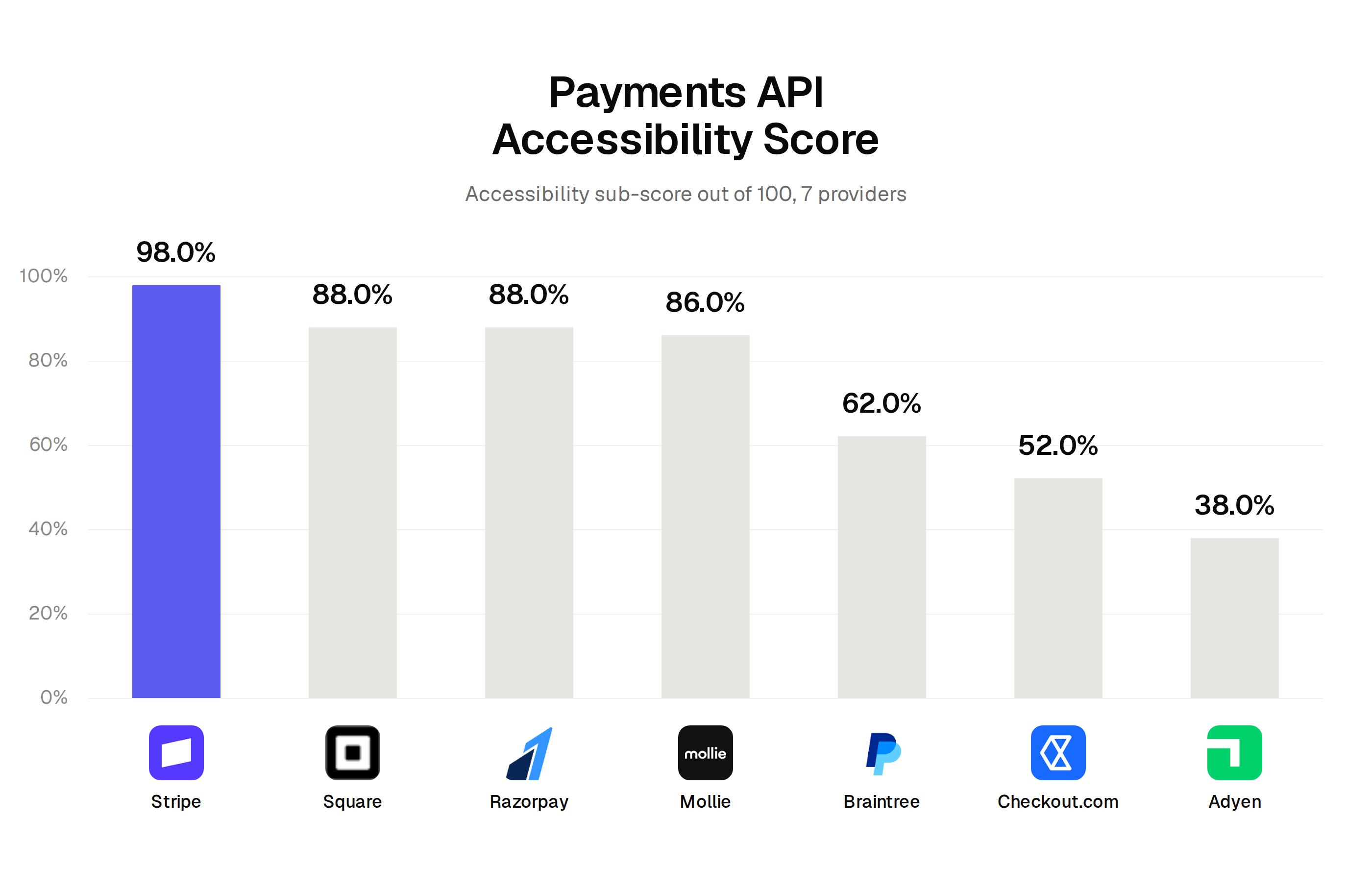
The bottom of this chart is why the overall table looks the way it does. Braintree scores 62, Checkout.com 52 and Adyen 38. The gap between Stripe and Adyen on this one measure is 60 points.
The index records the reasons in each provider's free tier and pricing fields:
- Checkout.com offers a self-serve sandbox test account, but live pricing is sales-quoted.
- Adyen gives a test environment only after account approval, with no instant key.
- Braintree has a free sandbox account, and live rates are not always published.
The three providers at the top of the access chart all offer a free sandbox or test mode that needs no sales contact. That is a different thing from the quality of the API once you are live, which is what the reliability score covers.
How was this benchmark measured?
This post uses the APIbenchmarks Index, not a hands-on test. There is no fixed panel of payments with known answers behind these numbers, so no result here is a pass rate or an accuracy figure.
- What is scored. Documentation, reliability, ecosystem and accessibility, each on a scale up to 100, combined into one index score and a letter grade.
- Who is scored. 7 payments APIs: Stripe, Square, Razorpay, Mollie, Braintree, Checkout.com and Adyen.
- When. Each score on the page carries a verified date. For all 7 payments providers it is 2026-06-27.
- What else is recorded. The pricing model, the free tier and what each API is best for, taken from the same index entry.
Two limits matter before you act on the numbers. First, an index score is not a transaction success rate, an approval rate or a measure of fees you will pay. It says nothing about how a provider performs for your card mix, your countries or your volume. Second, the scores reflect the verified date, and pricing and free tiers change. The methodology page explains the index in full.
Why do the rankings change between the sub-scores?
Because the four measures reward different things, and the providers are not built for the same buyer. The chart below puts reliability and accessibility side by side for every provider.
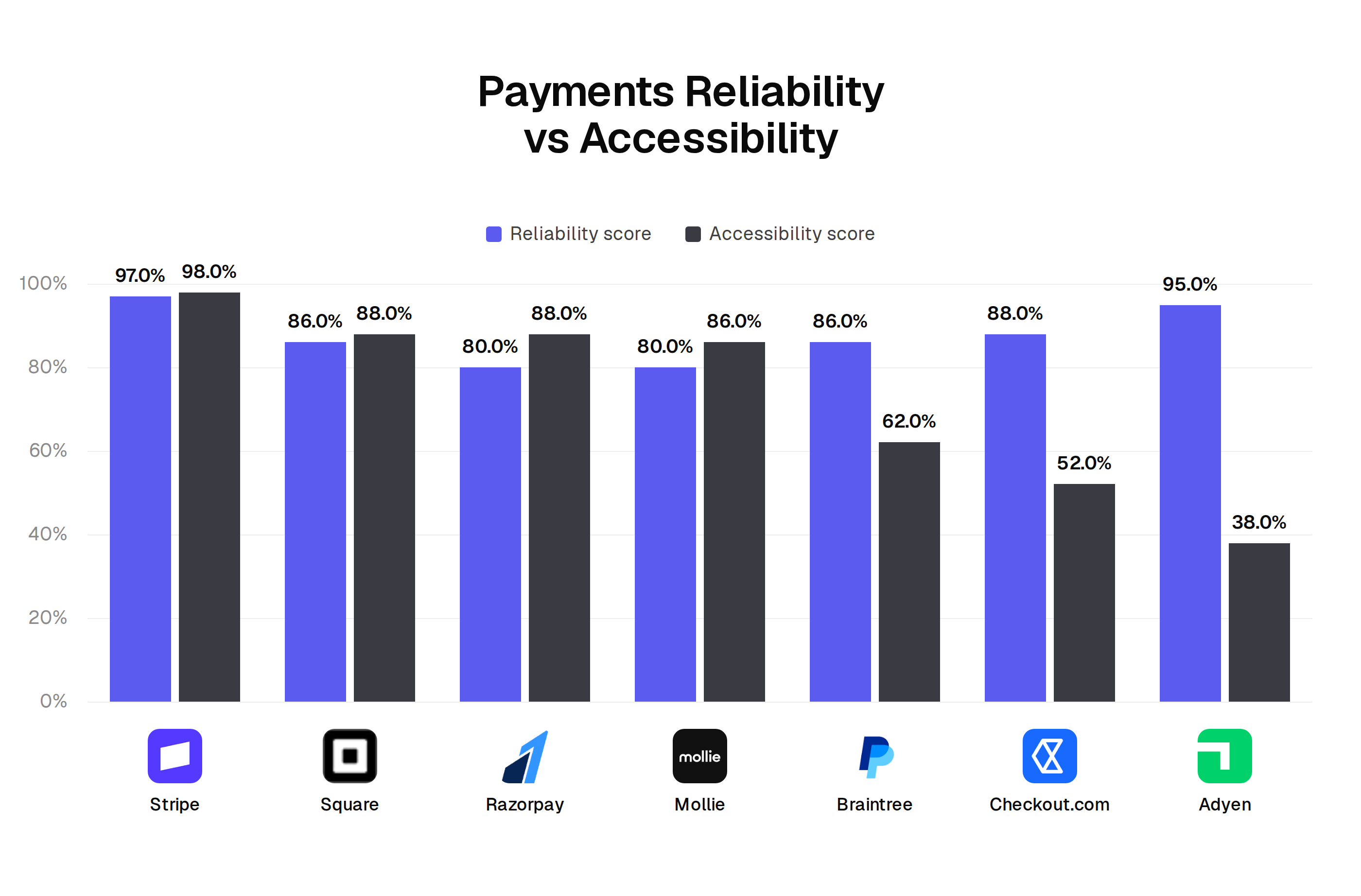
Adyen moves the most. It is second on reliability at 95 and last on accessibility at 38, a spread of 57 points between its two scores. Checkout.com has the same shape on a smaller scale, 88 on reliability and 52 on accessibility.
Razorpay and Mollie show the reverse. Their reliability scores are both 80, below Square, Braintree, Checkout.com and Adyen, but their accessibility scores are 88 and 86, second (tied) and fourth in the group. Mollie's index entry describes it as a European local payment methods provider, and Razorpay's as an India-first developer payments suite. Neither description is tested here, so read the scores as the index's view of documentation and access, not as a measure of local method coverage.
Stripe is the one provider without a gap. Its lowest sub-score is 97 and its highest is 98.
How do these providers compare on pricing and free access?
Index scores do not capture cost. The index records each provider's pricing model and free tier, and they differ more than the scores do.
| Provider | Pricing model | Free access |
|---|---|---|
| Stripe | Per transaction (2.9% + $0.30) | Unlimited test-mode sandbox, no card |
| Square | Per transaction (2.6% + $0.15 in-person) | Free APIs, SDKs and sandbox |
| Razorpay | Per transaction (~2% + GST) | Free test mode, no monthly fee |
| Mollie | Per transaction (1.8% + €0.25 EU cards) | No setup or monthly fee, free test mode |
| Braintree | Per transaction (2.59% + $0.49) | Free sandbox account |
| Checkout.com | Custom (flat or interchange++) | Self-serve sandbox, live pricing sales-quoted |
| Adyen | Interchange++ (€0.11 + IC + ~0.6%) | Test environment after account approval |
Stripe has the highest index score and a published per-transaction rate, so it is easy to model. Mollie lists the lowest percentage fee in the table at 1.8% for EU cards, and Razorpay lists about 2%. Checkout.com and Adyen use custom or interchange-plus pricing, which can suit high volume but cannot be priced without a quote or a model of your card mix. These fees are as recorded in the index and are not a comparison of what you would pay in practice.
Compare two providers directly with Square vs Stripe or Adyen vs Stripe. Provider pages are at Stripe, Square, Razorpay, Mollie, Braintree, Checkout.com and Adyen.
The bottom line on each provider
- Stripe. First at 97.5 and first on all four sub-scores. Published per-transaction pricing and a no-card test mode.
- Square. Second at 85.9, with an accessibility score of 88. Free APIs, SDKs and sandbox.
- Razorpay. Third at 82.2. Accessibility of 88, reliability of 80.
- Mollie. Fourth at 81.4. Documentation of 84, ecosystem of 76, the lowest in the group alongside Checkout.com.
- Braintree. Fifth at 77.9. Reliability of 86, accessibility of 62.
- Checkout.com. Sixth at 76.6. Reliability of 88, accessibility of 52, and live pricing is sales-quoted.
- Adyen. Seventh at 76.1. Reliability of 95, accessibility of 38, and a test environment only after account approval.
How to benchmark payments providers yourself
An index score is a starting point. The test that matters is your own traffic. Pick the 2 or 3 providers that fit your region and card mix, open a sandbox with each, and run the same set of test payments, refunds and webhook events through all of them. Count how long it takes to get a first successful charge, how many support or sales steps stand in the way, and whether the documentation answers the questions you actually hit. Then ask each provider for a live rate sheet on the same assumptions so the fees are comparable. The same approach works in other categories, as in the SMS API benchmark, where the index scores are laid out for a different set of providers.
FAQ
What is the best payments API? Stripe, on the APIbenchmarks Index. It scores 97.5 (A+), ahead of Square at 85.9 (A), Razorpay at 82.2, Mollie at 81.4, Braintree at 77.9, Checkout.com at 76.6 and Adyen at 76.1.
Is Stripe better than Square? On the index, yes, by 11.6 points: 97.5 against 85.9. Stripe is ahead on documentation (98 against 86), reliability (97 against 86), ecosystem (97 against 84) and accessibility (98 against 88).
Which payments API is the most reliable? Stripe, with a reliability score of 97. Adyen is second at 95, followed by Checkout.com at 88 and Square and Braintree at 86.
Why is Adyen last if its reliability is so high? Its accessibility score is 38, the lowest in the group, because the test environment is only available after account approval and there is no instant key. Reliability counts for one of four sub-scores, so a low access score pulls the total down to 76.1.
Does this benchmark measure approval rates or fees? No. The index scores documentation, reliability, ecosystem and accessibility. It records pricing models and free tiers but does not test how many of your payments succeed or what you would pay at your volume.
More benchmarks
- Social posts API benchmark 2026: Fiber, Crustdata and Bright Data
- Job postings API benchmark 2026: TheirStack, Bright Data and Crustdata
- People search API benchmark 2026: Crustdata, Fiber and Exa
- Authentication API benchmark 2026: Auth0, Firebase, WorkOS, Clerk, Stytch and more
- LLM API benchmark 2026: OpenAI, Claude, Gemini, Mistral, Grok, Groq and DeepSeek
- Transactional email API benchmark 2026: SendGrid, Resend, Postmark, Mailgun and more
- Vector database API benchmark 2026: Pinecone, MongoDB Atlas, Zilliz, Supabase and more
- Text-to-speech API benchmark 2026: ElevenLabs, Google Cloud, Polly, OpenAI and more
- Maps and geocoding API benchmark 2026: Google Maps Platform, Mapbox, HERE, TomTom and more
- Crustdata vs People Data Labs API benchmark 2026: company and person matching
- E-signature API benchmark 2026: DocuSign, Dropbox Sign, PandaDoc and 4 more
- KYC API benchmark 2026: Stripe Identity, Persona, Plaid, Sumsub and more
- Personal email API benchmark 2026: ContactOut, FullEnrich, Nyne, SignalHire, Wiza and Apollo
- SMS API benchmark 2026: Twilio, Vonage, Telnyx, Plivo, Sinch and more
- Person enrichment API benchmark 2026: Coresignal, Nyne, Crustdata, Fiber and People Data Labs
- Data enrichment API benchmark 2026: Crustdata, People Data Labs, Bright Data and 16 more
- Semantic search API benchmark 2026: Crustdata, Exa and Parallel
- Translation API benchmark 2026: Google, Azure, Amazon, DeepL, Lara, Lokalise and LILT
- Image generation API benchmark 2026: OpenAI, Google Imagen, fal.ai, Replicate and more
- Company enrichment API benchmark 2026: Crustdata, Fiber, Coresignal, People Data Labs and Nyne
- Technographics data benchmark 2026: Crustdata vs BuiltWith vs TheirStack vs Sumble