
LLM API benchmark 2026: OpenAI, Claude, Gemini, Mistral, Grok, Groq and DeepSeek
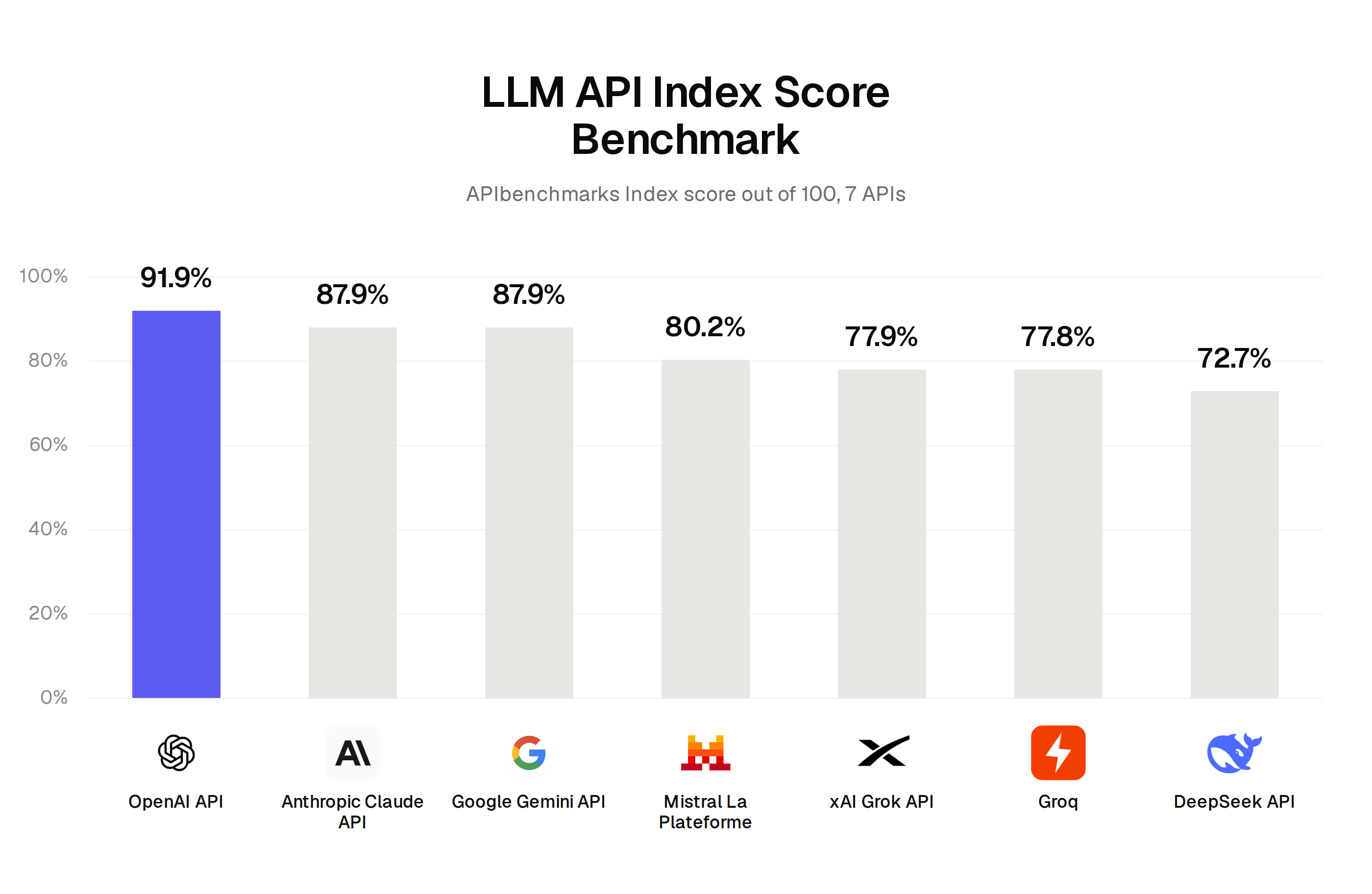
OpenAI API leads the LLM index at 91.9 out of 100, ahead of Anthropic Claude and Google Gemini at 87.9 each. DeepSeek is last of seven at 72.7.
The OpenAI API has the highest score of the seven LLM APIs in the APIbenchmarks Index, 91.9 out of 100. The Anthropic Claude API and the Google Gemini API tie for second at 87.9. Mistral La Plateforme scores 80.2, xAI Grok API 77.9, Groq 77.8 and DeepSeek API 72.7. The widest gap between APIs is on reliability, where OpenAI scores 90 and DeepSeek scores 64.
An LLM API lets you send a prompt to a hosted language model and get text back, billed per token. This post uses the index, which scores each API out of 100 on documentation, reliability, ecosystem and accessibility. It is not a test of answer quality, speed or cost per task, and no such numbers are in this post.
The short version:
- OpenAI leads at 91.9, 4.0 points ahead of Anthropic Claude and Google Gemini, which tie at 87.9.
- Reliability splits the field in two. OpenAI, Gemini and Claude score 90, 89 and 88. The other four score 76 or lower.
- Groq has the highest accessibility score at 92, and the lowest documentation score of the top six at 78.
Which LLM API scores highest?
The OpenAI API, at 91.9. It, Anthropic Claude and Google Gemini are the three APIs with grade A. Mistral, xAI Grok and Groq are grade B, and DeepSeek is grade C.
| Provider | Index score | Grade |
|---|---|---|
| OpenAI API | 91.9 | A |
| Anthropic Claude API | 87.9 | A |
| Google Gemini API | 87.9 | A |
| Mistral La Plateforme | 80.2 | B |
| xAI Grok API | 77.9 | B |
| Groq | 77.8 | B |
| DeepSeek API | 72.7 | C |
The table has three tiers. OpenAI is alone at the top. Claude and Gemini tie, 4.0 points behind. Then there is a drop of 7.7 points to Mistral at 80.2. xAI Grok and Groq are 0.1 points apart, so their order is close to a tie. From OpenAI down to DeepSeek the range is 19.2 points. The full scores are on the LLM category page and the verdict page.
Which LLM API is the most reliable?
OpenAI, with a reliability score of 90. Google Gemini is at 89 and Anthropic Claude at 88. Then the scores fall to 76 for xAI Grok, 74 for Mistral, 72 for Groq and 64 for DeepSeek.
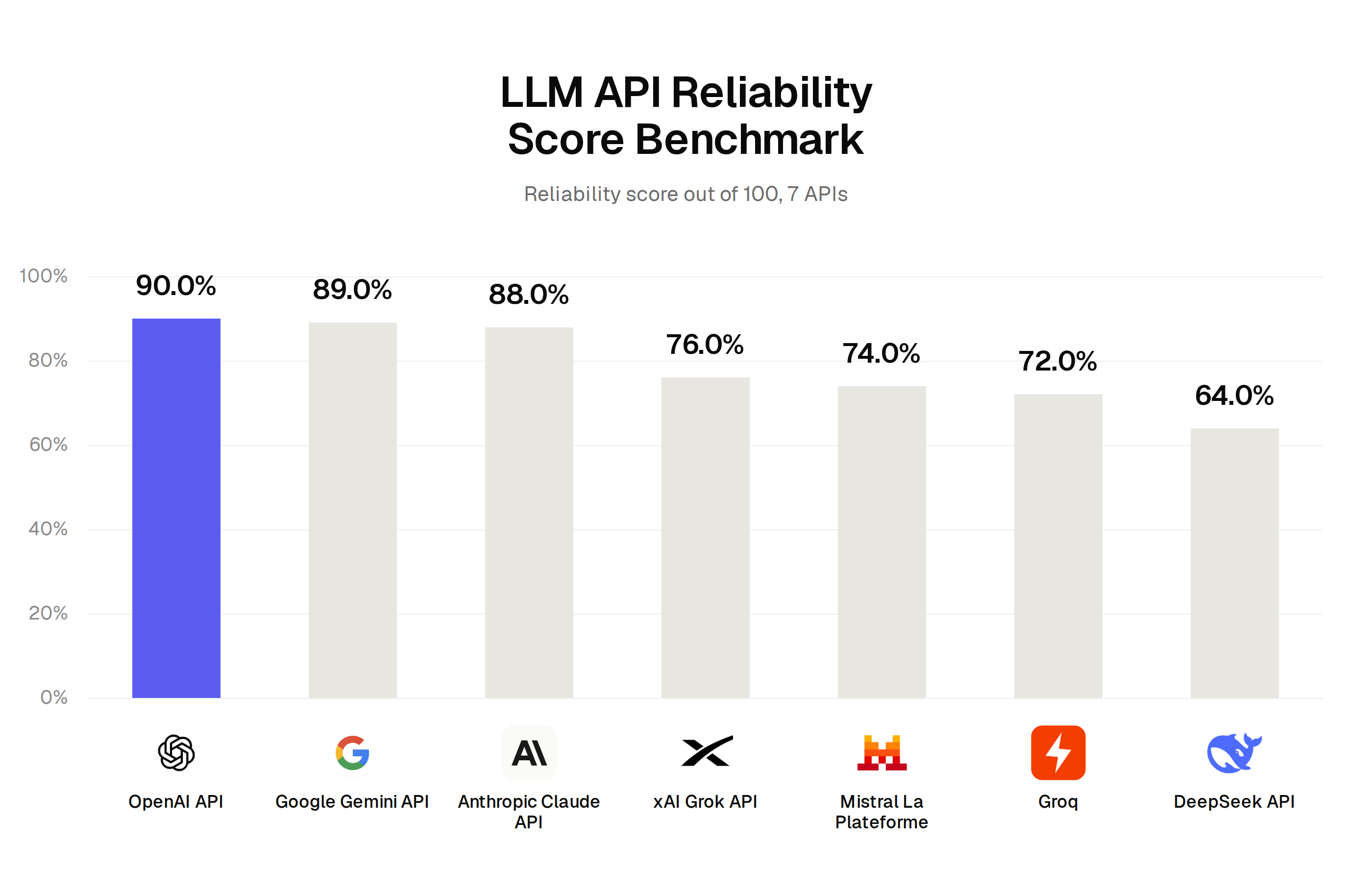
The top three are within 2 points of each other. The gap between third place and fourth is 12 points, the largest step in the chart. DeepSeek scores 64 against 90 for OpenAI, and its reliability score is the main reason it is last in the index. This dimension is an index score, not an uptime measurement taken for this post.
How was this benchmark measured?
This is an index category, so every number comes from the APIbenchmarks Index and not from a hands-on test.
- Four scores. Each API is scored out of 100 on documentation, reliability, ecosystem and accessibility. The index score combines them.
- Same scale for all. All seven APIs are scored on the same four dimensions.
- Verified date. The data for these seven APIs was last verified on 2026-06-27. The index was updated on 2026-11-16.
- Seven APIs. OpenAI API, Anthropic Claude API, Google Gemini API, Mistral La Plateforme, xAI Grok API, Groq and DeepSeek API.
The limits are plain. The index does not run a fixed panel with known answers through each API and grade the responses against ground truth, which is how the site's hands-on benchmarks work. So a high score here does not mean better answers on your prompts, lower latency or a lower bill. Prices and free tiers change, so check each provider before you rely on a figure here. The methodology page explains the scoring.
Do the scores differ more on documentation or accessibility?
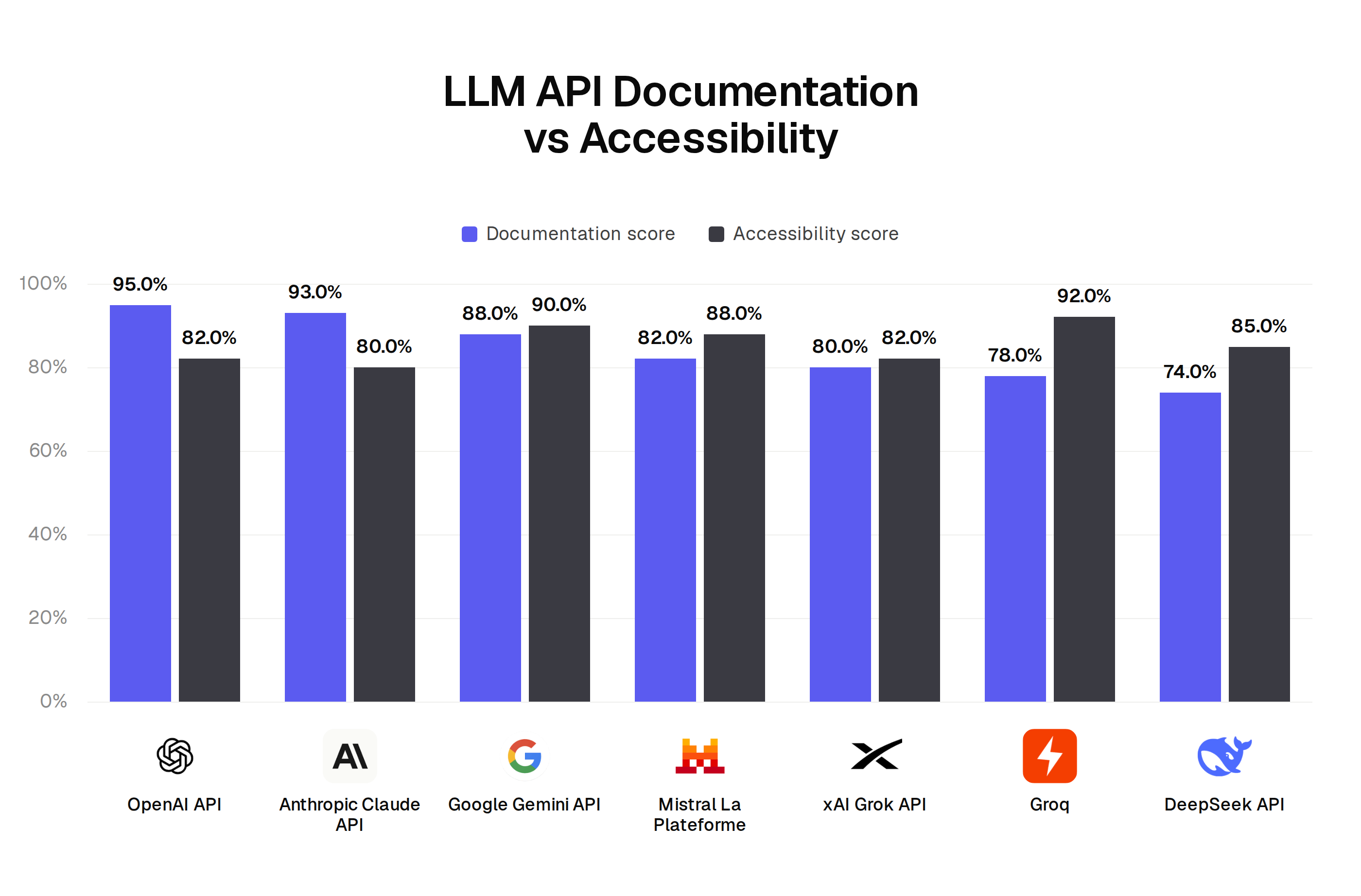
Both spread widely, and they point in different directions for some APIs. The chart puts the two side by side.
| Provider | Documentation | Reliability | Ecosystem | Accessibility |
|---|---|---|---|---|
| OpenAI API | 95 | 90 | 98 | 82 |
| Anthropic Claude API | 93 | 88 | 88 | 80 |
| Google Gemini API | 88 | 89 | 85 | 90 |
| Mistral La Plateforme | 82 | 74 | 78 | 88 |
| xAI Grok API | 80 | 76 | 74 | 82 |
| Groq | 78 | 72 | 72 | 92 |
| DeepSeek API | 74 | 64 | 70 | 85 |
OpenAI is first on documentation, reliability and ecosystem, and its ecosystem score of 98 is the highest single number in the table. Accessibility is where it does not lead. Groq scores 92 and Gemini 90, against 82 for OpenAI and 80 for Claude, the lowest accessibility score of the seven.
Documentation and accessibility run in opposite directions for the lower half. Groq scores 78 on documentation and 92 on accessibility, a gap of 14 points. DeepSeek scores 74 and 85. OpenAI and Claude show the reverse, with documentation 13 points above accessibility for both.
Which LLM API is easiest to start with?
Groq has the highest accessibility score at 92, and Google Gemini follows at 90. The free tier details from the index explain part of that.
| Provider | Accessibility | Free access | Pricing model |
|---|---|---|---|
| Groq | 92 | Free dev tier, no card: 30 RPM, 6K TPM, 14,400 requests a day | Per token |
| Google Gemini API | 90 | Free tier on Flash models, about 1,500 requests a day and 250k TPM. Pro models paid only since April 2026 | Per token |
| Mistral La Plateforme | 88 | Free Experiment tier, rate limited, about 1B tokens a month cap, all models | Per token |
| DeepSeek API | 85 | 5M free tokens on signup, valid 30 days, no card | Per token |
| OpenAI API | 82 | $5 trial credit after ID verification, opt-in data sharing free tokens | Per token |
| xAI Grok API | 82 | Pay as you go, periodic free credit promos, no guaranteed standing free tier | Per token |
| Anthropic Claude API | 80 | Trial credits on signup, no ongoing API free tier | Per token |
Every API in this category bills per token, so price per token is where the real comparison sits, and the index does not record it here. Three APIs have a standing free tier that lets you keep testing: Groq, Gemini and Mistral. The other four give trial credits or promos that run out.
Which APIs are close enough to compare directly?
Three pairs are worth a direct look.
- Anthropic Claude and Google Gemini. Both score 87.9. Claude is ahead on documentation (93 against 88) and ecosystem (88 against 85). Gemini is ahead on reliability (89 against 88) and accessibility (90 against 80). See Claude vs Gemini.
- OpenAI and Anthropic Claude. 91.9 against 87.9, a gap of 4.0. OpenAI is ahead on all four dimensions, and the closest are accessibility at 82 against 80 and reliability at 90 against 88. See Claude vs OpenAI.
- xAI Grok and Groq. 77.9 against 77.8. Grok is ahead on documentation, reliability and ecosystem, and Groq is ahead on accessibility, 92 against 82. See Groq vs xAI Grok.
The bottom line on each provider
- OpenAI API. First at 91.9, grade A. Highest documentation (95), reliability (90) and ecosystem (98). Accessibility is 82 and the free access is a $5 trial credit after ID verification.
- Anthropic Claude API. Tied second at 87.9. Documentation of 93, second to OpenAI. Accessibility of 80 is the lowest of the seven, with trial credits and no ongoing free tier.
- Google Gemini API. Tied second at 87.9. Accessibility of 90 and a free tier on Flash models. Reliability of 89 is second to OpenAI.
- Mistral La Plateforme. 80.2, grade B. Accessibility of 88 with a free Experiment tier on all models, and reliability of 74.
- xAI Grok API. 77.9, grade B. Reliability of 76 is the best of the four lower scoring APIs. No guaranteed free tier.
- Groq. 77.8, grade B. The highest accessibility at 92 and a free dev tier, with documentation of 78 and ecosystem of 72.
- DeepSeek API. Last at 72.7, grade C. Reliability of 64 is the lowest score on that dimension, and ecosystem of 70 is the lowest on that one.
How to benchmark LLM providers yourself
An index score tells you how easy an API is to adopt and how well it is documented. It cannot tell you how a model answers your prompts. To test that, collect a few hundred real prompts from your own product where you already know the right answer, such as support tickets with a known resolution or documents with a known extraction. Send the same list to each provider, and count a result as correct only when it matches the answer you already know. Record the time to each response too, since the index does not measure latency. For worked examples of grading providers against a known answer, see the technographics benchmark and the translation API benchmark, which uses the same index for another category.
FAQ
What is the best LLM API? In the APIbenchmarks Index it is the OpenAI API, with a score of 91.9 and grade A. Anthropic Claude and Google Gemini tie for second at 87.9. The index scores documentation, reliability, ecosystem and accessibility, and does not measure answer quality.
Which LLM API is the most reliable? OpenAI, with a reliability score of 90. Google Gemini scores 89 and Anthropic Claude 88. DeepSeek is lowest at 64.
Which LLM API has a free tier? Groq has a free dev tier with no card, Google Gemini has a free tier on Flash models, and Mistral has a free Experiment tier on all models. DeepSeek gives 5M free tokens on signup, valid for 30 days. OpenAI and Anthropic give trial credits, and xAI has no guaranteed standing free tier.
Is OpenAI or Anthropic Claude better? OpenAI scores higher in the index, 91.9 against 87.9, and is ahead on documentation, reliability, ecosystem and accessibility. The closest dimension is reliability, 90 against 88. The full comparison has the detail.
Is this a test of which model gives the best answers? No. These are index scores, last verified on 2026-06-27. No panel of known answers was sent through the APIs for this post, so it does not show accuracy, speed or cost per task.
More benchmarks
- Social posts API benchmark 2026: Fiber, Crustdata and Bright Data
- Job postings API benchmark 2026: TheirStack, Bright Data and Crustdata
- People search API benchmark 2026: Crustdata, Fiber and Exa
- Authentication API benchmark 2026: Auth0, Firebase, WorkOS, Clerk, Stytch and more
- Transactional email API benchmark 2026: SendGrid, Resend, Postmark, Mailgun and more
- Vector database API benchmark 2026: Pinecone, MongoDB Atlas, Zilliz, Supabase and more
- Text-to-speech API benchmark 2026: ElevenLabs, Google Cloud, Polly, OpenAI and more
- Payments API benchmark 2026: Stripe, Square, Razorpay, Mollie, Braintree, Checkout.com, Adyen
- Maps and geocoding API benchmark 2026: Google Maps Platform, Mapbox, HERE, TomTom and more
- Crustdata vs People Data Labs API benchmark 2026: company and person matching
- E-signature API benchmark 2026: DocuSign, Dropbox Sign, PandaDoc and 4 more
- KYC API benchmark 2026: Stripe Identity, Persona, Plaid, Sumsub and more
- Personal email API benchmark 2026: ContactOut, FullEnrich, Nyne, SignalHire, Wiza and Apollo
- SMS API benchmark 2026: Twilio, Vonage, Telnyx, Plivo, Sinch and more
- Person enrichment API benchmark 2026: Coresignal, Nyne, Crustdata, Fiber and People Data Labs
- Data enrichment API benchmark 2026: Crustdata, People Data Labs, Bright Data and 16 more
- Semantic search API benchmark 2026: Crustdata, Exa and Parallel
- Translation API benchmark 2026: Google, Azure, Amazon, DeepL, Lara, Lokalise and LILT
- Image generation API benchmark 2026: OpenAI, Google Imagen, fal.ai, Replicate and more
- Company enrichment API benchmark 2026: Crustdata, Fiber, Coresignal, People Data Labs and Nyne
- Technographics data benchmark 2026: Crustdata vs BuiltWith vs TheirStack vs Sumble