
Head to head
Open-Meteo vs OpenWeather
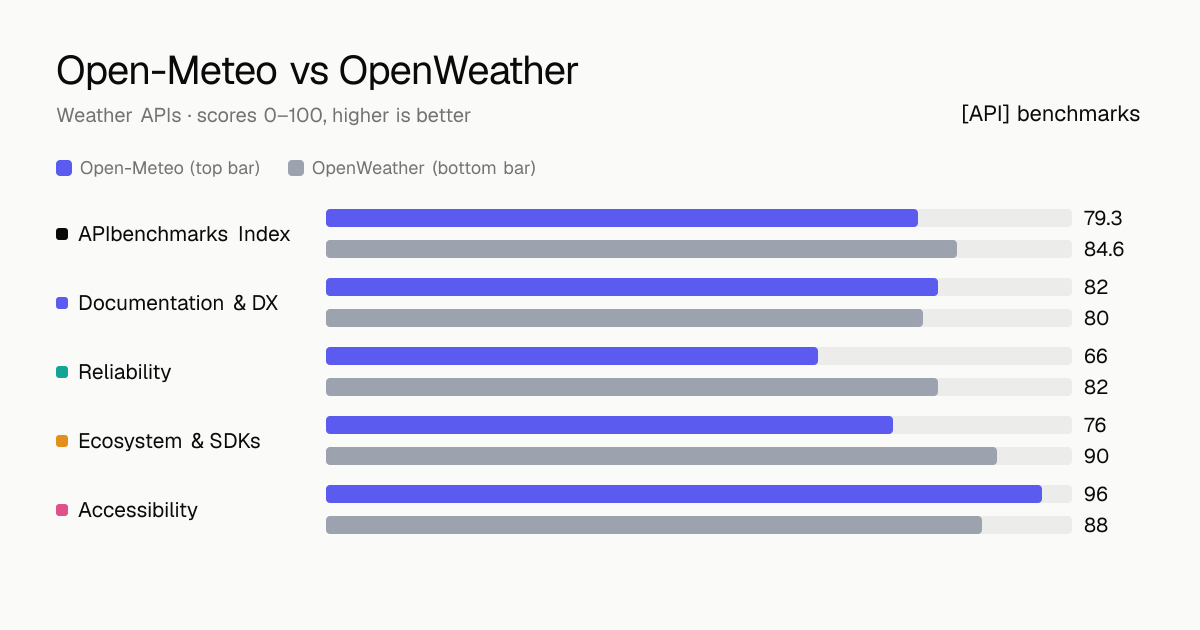
As a weather API, OpenWeather rates higher on the APIbenchmarks Index, 84.6 to 79.3, a 5.3-point gap. Here is how they compare on each criterion.
Criterion by criterion
| Criterion | Open-Meteo | OpenWeather |
|---|---|---|
| Documentation & DX | ||
| Reliability | ||
| Ecosystem & SDKs | ||
| Accessibility | ||
| APIbenchmarks Index | 79.3 | 84.6 |
Specifications
| Open-Meteo | OpenWeather | |
|---|---|---|
| Best for | Free open-source weather API | Ubiquitous developer weather API |
| Free tier | 10k calls/day, no key (non-commercial) | 1M calls/mo (classic) + 1k One Call calls/day |
| Pricing | Free non-commercial / per-call commercial | Per call / freemium tiers |
| Official SDKs | 7 languages | 5 languages |
Is Open-Meteo better than OpenWeather?
On the APIbenchmarks Index, OpenWeather rates higher (84.6 vs 79.3). It leads on the four weighted criteria, but price is reported separately, so the best choice still depends on your budget.
Verdict in one line
OpenWeather leads by 5.3 points (84.6 vs 79.3) and wins 2 of 4 criteria; Open-Meteo wins 2.
Winner by criterion
| Criterion | Winner | ||
|---|---|---|---|
| Documentation & DX | 82 | 80 | |
| Reliability | 66 | 82 | |
| Ecosystem & SDKs | 76 | 90 | |
| Accessibility | 96 | 88 |
Choose Open-Meteo if… / choose OpenWeather if…
- →documentation & dx matters most to you (82 vs 80)
- →accessibility matters most to you (96 vs 88)
- →you need broad SDK coverage (7 official SDKs vs 5)
- →your use case matches its focus: free open-source weather api
- →reliability matters most to you (82 vs 66)
- →ecosystem & sdks matters most to you (90 vs 76)
- →your use case matches its focus: ubiquitous developer weather api
Pricing side by side
- Model
- Free non-commercial / per-call commercial
- Free tier
- 10k calls/day, no key (non-commercial)
- Free / Open-Access (non-commercial)$0
- API Standard$29/mo
- API Professional$99/mo
- API EnterpriseCustom (contact info@open-meteo.com)
- Model
- Per call / freemium tiers
- Free tier
- 1M calls/mo (classic) + 1k One Call calls/day
- Free$0
- One Call API 3.0 (pay as you call)1,000 calls/day free, then ~0.0012 GBP (~$0.0015) per call
- Startup~$40/month
- Developer~$180/month
- Professional~$470/month
- Enterprisefrom $3,000/month
Vendor-published pricing, verified 2026-06-27 (Open-Meteo) and 2026-06-27 (OpenWeather).
SDK and language coverage
Both · 1
Python
Only Open-Meteo · 6
TypeScriptSwiftKotlinJavaR (community)Dart (community)
Only OpenWeather · 4
REST/JSON (HTTP, language-agnostic)Java / Android (OWM JAPIs, community)JavaScript / Node.js (community wrappers)Curated community library list (awesome-openweather)
Strengths and weaknesses
- +No API key or account required for non-commercial use, a single HTTP GET returns JSON
- +Blends 30+ models from 15+ national weather services and auto-selects the best local high-res model per coordinate
- +Exceptionally broad data: forecast, historical (1940-present), marine, air quality, solar/PV, ensemble, seasonal, flood, climate
- –Model data only, no real station observations, so no validated actuals or hyperlocal radar nowcasting
- –Free tier rate limits (600/min, 5k/hr, 10k/day) frustrate some developers with bursty workloads
- –Commercial use legally requires a paid plan even at low volumes
- +Permanent free tier plus pay-as-you-call billing (1,000 free calls/day) makes it extremely cheap to start and prototype
- +One Call API 3.0 consolidates current, minute, hourly (48h), daily (8d), alerts and 47-year history into one endpoint
- +Hyperlocal ML model updated ~every 10 minutes; vendor cites <1% of temperature predictions deviating more than 5C
- –Reported inconsistency between the Geocoding API and weather endpoints (duplicate/mismatched city results)
- –Meaningful uptime (99.5%+) and faster data refresh are gated behind higher paid tiers; Startup targets only ~95%
- –No prominent public real-time status/incident page for self-service customers
Open-Meteo vs OpenWeather: questions
- Which has better documentation, Open-Meteo or OpenWeather?
- Open-Meteo scores higher on documentation and developer experience: 82 vs 80 out of 100.
- Which is more reliable, Open-Meteo or OpenWeather?
- OpenWeather scores higher on reliability: 82 vs 66 out of 100.
- Do Open-Meteo and OpenWeather have a free tier?
- Open-Meteo: yes (10k calls/day, no key (non-commercial)). OpenWeather: yes (1M calls/mo (classic) + 1k One Call calls/day).
- How are Open-Meteo and OpenWeather priced?
- Open-Meteo: Free non-commercial / per-call commercial. OpenWeather: Per call / freemium tiers.
- Which has more official SDKs?
- Open-Meteo lists 7 official SDKs, OpenWeather lists 5.