
Head to head
OpenAI Images (gpt-image) vs Stability AI
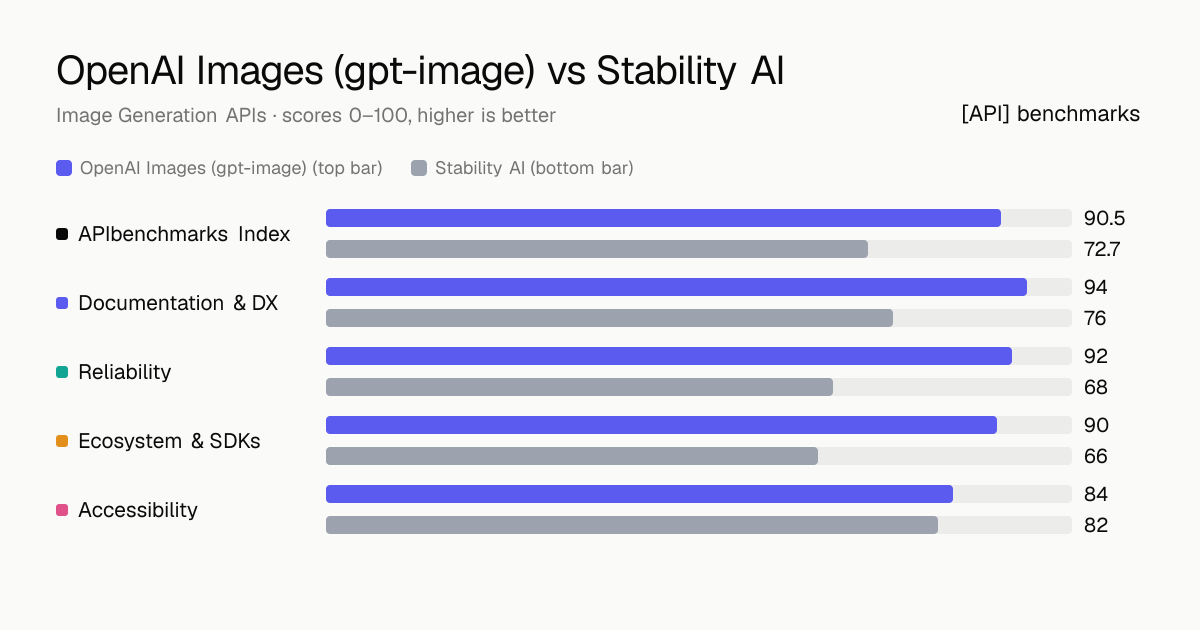
As a image generation API, OpenAI Images (gpt-image) rates higher on the APIbenchmarks Index, 90.5 to 72.7, a 17.8-point gap. Here is how they compare on each criterion.
90.5ABI / 100
Frontier image gen + editing inside the OpenAI platform
Criterion by criterion
| Criterion | OpenAI Images (gpt-image) | Stability AI |
|---|---|---|
| Documentation & DX | ||
| Reliability | ||
| Ecosystem & SDKs | ||
| Accessibility | ||
| APIbenchmarks Index | 90.5 | 72.7 |
Specifications
| OpenAI Images (gpt-image) | Stability AI | |
|---|---|---|
| Best for | Frontier image gen + editing inside the OpenAI platform | Direct Stable Diffusion / Stable Image API |
| Free tier | No | 25 free credits (~$0.25) on signup |
| Pricing | Per token (~$0.02-0.25/image) | Per image, credit-based ($0.03-0.08) |
| Official SDKs | 4 languages | 6 languages |
Is OpenAI Images (gpt-image) better than Stability AI?
On the APIbenchmarks Index, OpenAI Images (gpt-image) rates higher (90.5 vs 72.7). It leads on the four weighted criteria, but price is reported separately, so the best choice still depends on your budget.
Verdict in one line
OpenAI Images (gpt-image) leads by 17.8 points (90.5 vs 72.7) and wins 4 of 4 criteria.
Winner by criterion
| Criterion | Winner | ||
|---|---|---|---|
| Documentation & DX | 94 | 76 | |
| Reliability | 92 | 68 | |
| Ecosystem & SDKs | 90 | 66 | |
| Accessibility | 84 | 82 |
Choose OpenAI Images (gpt-image) if… / choose Stability AI if…
- →documentation & dx matters most to you (94 vs 76)
- →reliability matters most to you (92 vs 68)
- →ecosystem & sdks matters most to you (90 vs 66)
- →accessibility matters most to you (84 vs 82)
- →your use case matches its focus: frontier image gen + editing inside the openai platform
- →you want a free tier to start (25 free credits (~$0.25) on signup)
- →you need broad SDK coverage (6 official SDKs vs 4)
- →your use case matches its focus: direct stable diffusion / stable image api
Pricing side by side
- Model
- Per token (~$0.02-0.25/image)
- Free tier
- No
- gpt-image-1-mini$2.50 in / $8.00 out per 1M tokens
- gpt-image-1.5$8.00 in / $32.00 out per 1M tokens
- gpt-image-2 (flagship)$8.00 in / $30.00 out per 1M tokens
- gpt-image-1 (original)~$0.02 / $0.07 / $0.19 per image
- Model
- Per image, credit-based ($0.03-0.08)
- Free tier
- 25 free credits (~$0.25) on signup
- Stable Image Ultra$0.08 / image (8 credits)
- SD3.5 Large$0.065 / image (6.5 credits)
- SD3.5 Large Turbo$0.04 / image (4 credits)
- SD3.5 Medium / Stable Image Core$0.035 / $0.03 per image
- Edit & Control services$0.05 / op (5 credits)
- Upscalers$0.02-$0.60 / op (2-60 credits)
Vendor-published pricing, verified 2026-06-27 (OpenAI Images (gpt-image)) and 2026-06-27 (Stability AI).
SDK and language coverage
Both · 1
Python (official openai SDK)
Only OpenAI Images (gpt-image) · 3
JavaScript / TypeScript / Node.js (official openai SDK)cURL / RESTAzure OpenAI SDKs (.NET, Java, etc.)
Only Stability AI · 5
gRPC / Protobuf (compile stubs for any language)REST/HTTP (language-agnostic)Available via Amazon Bedrock SDKsAvailable via fal.ai client librariesAvailable via Replicate client libraries
Strengths and weaknesses
- +Best-in-class prompt/instruction following and accurate in-image text rendering; ranks at/near the top of Artificial Analysis's Text-to-Image Arena
- +Native multimodal model accepts text + multiple reference images for editing, inpainting, style transfer and background expansion
- +Conversational Responses API enables multi-turn, high-fidelity iterative edits across turns
- –High latency: high-quality generations commonly take 30–60s and the API can time out around 180s, hurting interactive UX
- –More expensive and slower than self-hosted open-weight diffusion models for high-volume use
- –Original gpt-image-1 had a noticeable yellow/warm color tint
- +Open-weights models, prototype on the API then self-host the identical model for zero marginal per-image cost
- +Best-in-class typography and prompt adherence; human-preference evals beat DALL-E 3 and Midjourney v6 on text rendering
- +Unusually broad endpoint set: text-to-image, edit/inpaint, ControlNet conditioning, 3 upscalers, 3D, and audio under one key
- –Raw aesthetic quality still widely seen as trailing Midjourney for hero/marketing imagery
- –Steep learning curve and heavy prompt/hardware dependence, especially on the open-source self-host path
- –No public status page or formal uptime SLA on the self-serve API tier
OpenAI Images (gpt-image) vs Stability AI: questions
- Which has better documentation, OpenAI Images (gpt-image) or Stability AI?
- OpenAI Images (gpt-image) scores higher on documentation and developer experience: 94 vs 76 out of 100.
- Which is more reliable, OpenAI Images (gpt-image) or Stability AI?
- OpenAI Images (gpt-image) scores higher on reliability: 92 vs 68 out of 100.
- Do OpenAI Images (gpt-image) and Stability AI have a free tier?
- OpenAI Images (gpt-image): no free tier. Stability AI: yes (25 free credits (~$0.25) on signup).
- How are OpenAI Images (gpt-image) and Stability AI priced?
- OpenAI Images (gpt-image): Per token (~$0.02-0.25/image). Stability AI: Per image, credit-based ($0.03-0.08).
- Which has more official SDKs?
- Stability AI lists 6 official SDKs, OpenAI Images (gpt-image) lists 4.
Other Image Generation comparisons
Google Imagen / Gemini Image vs OpenAI Images (gpt-image)fal.ai vs OpenAI Images (gpt-image)OpenAI Images (gpt-image) vs ReplicateBlack Forest Labs (FLUX) vs OpenAI Images (gpt-image)Ideogram vs OpenAI Images (gpt-image)Google Imagen / Gemini Image vs Stability AIfal.ai vs Stability AIReplicate vs Stability AI