
Head to head
Black Forest Labs (FLUX) vs OpenAI Images (gpt-image)
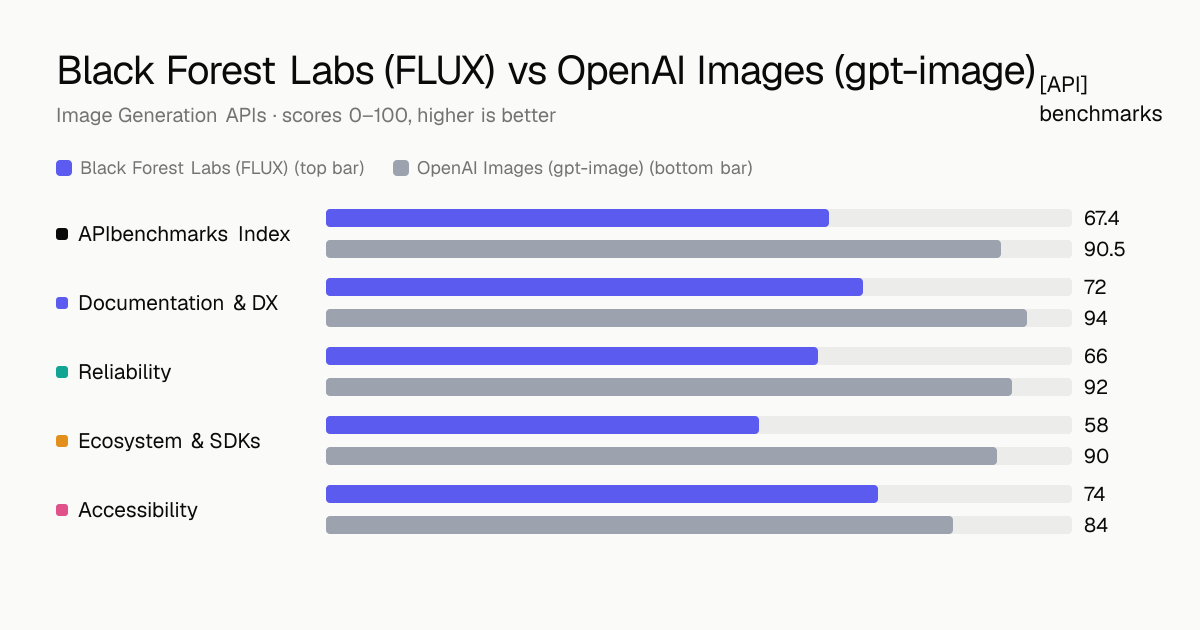
As a image generation API, OpenAI Images (gpt-image) rates higher on the APIbenchmarks Index, 90.5 to 67.4, a 23.1-point gap. Here is how they compare on each criterion.
90.5ABI / 100
Frontier image gen + editing inside the OpenAI platform
Criterion by criterion
| Criterion | Black Forest Labs (FLUX) | OpenAI Images (gpt-image) |
|---|---|---|
| Documentation & DX | ||
| Reliability | ||
| Ecosystem & SDKs | ||
| Accessibility | ||
| APIbenchmarks Index | 67.4 | 90.5 |
Specifications
| Black Forest Labs (FLUX) | OpenAI Images (gpt-image) | |
|---|---|---|
| Best for | First-party FLUX.2 generation + editing | Frontier image gen + editing inside the OpenAI platform |
| Free tier | No | No |
| Pricing | Per megapixel, credit-based ($0.015-0.07/MP) | Per token (~$0.02-0.25/image) |
| Official SDKs | 7 languages | 4 languages |
Is Black Forest Labs (FLUX) better than OpenAI Images (gpt-image)?
On the APIbenchmarks Index, OpenAI Images (gpt-image) rates higher (90.5 vs 67.4). It leads on the four weighted criteria, but price is reported separately, so the best choice still depends on your budget.
Verdict in one line
OpenAI Images (gpt-image) leads by 23.1 points (90.5 vs 67.4) and wins 4 of 4 criteria.
Winner by criterion
| Criterion | Winner | ||
|---|---|---|---|
| Documentation & DX | 72 | 94 | |
| Reliability | 66 | 92 | |
| Ecosystem & SDKs | 58 | 90 | |
| Accessibility | 74 | 84 |
Choose Black Forest Labs (FLUX) if… / choose OpenAI Images (gpt-image) if…
- →you need broad SDK coverage (7 official SDKs vs 4)
- →your use case matches its focus: first-party flux.2 generation + editing
- →documentation & dx matters most to you (94 vs 72)
- →reliability matters most to you (92 vs 66)
- →ecosystem & sdks matters most to you (90 vs 58)
- →accessibility matters most to you (84 vs 74)
- →your use case matches its focus: frontier image gen + editing inside the openai platform
Pricing side by side
- Model
- Per megapixel, credit-based ($0.015-0.07/MP)
- Free tier
- No
- FLUX.2 [pro]from $0.03/image
- FLUX.2 [flex]from $0.05/image
- FLUX1.1 [pro]$0.04/image
- FLUX1.1 [pro] Ultra$0.06/image
- FLUX.1 Kontext [pro]$0.04/image
- FLUX.1 Kontext [max]$0.08/image
- Model
- Per token (~$0.02-0.25/image)
- Free tier
- No
- gpt-image-1-mini$2.50 in / $8.00 out per 1M tokens
- gpt-image-1.5$8.00 in / $32.00 out per 1M tokens
- gpt-image-2 (flagship)$8.00 in / $30.00 out per 1M tokens
- gpt-image-1 (original)~$0.02 / $0.07 / $0.19 per image
Vendor-published pricing, verified 2026-06-27 (Black Forest Labs (FLUX)) and 2026-06-27 (OpenAI Images (gpt-image)).
SDK and language coverage
Both · 1
Python (community / examples)
Only Black Forest Labs (FLUX) · 6
REST API (HTTP)Official inference repo on GitHub (PyTorch)Hugging Face Diffusers integrationComfyUI nodesMCP serverThird-party access via fal.ai, Replicate, Together AI, NVIDIA NIM, Azure AI Foundry
Only OpenAI Images (gpt-image) · 3
JavaScript / TypeScript / Node.js (official openai SDK)cURL / RESTAzure OpenAI SDKs (.NET, Java, etc.)
Strengths and weaknesses
- +Frontier image quality at low cost, FLUX.2 [pro] launched #2 on the Artificial Analysis T2I Arena while costing under a quarter of the top model
- +Fast in-context editing: FLUX.1 Kontext averages ~0.9s per 1024x1024 edit, ~8x faster than diffusion-based editors per BFL
- +Pure pay-per-image metering (1 credit = $0.01), no subscriptions, seats or minimums
- –Aggressive, opaque content moderation: developers report frequent 'Request Moderated' errors on requests they consider valid
- –No official multi-language SDK, integration is raw REST plus community libraries
- –Asynchronous poll-based API (submit then poll) rather than a simple synchronous call adds integration complexity
- +Best-in-class prompt/instruction following and accurate in-image text rendering; ranks at/near the top of Artificial Analysis's Text-to-Image Arena
- +Native multimodal model accepts text + multiple reference images for editing, inpainting, style transfer and background expansion
- +Conversational Responses API enables multi-turn, high-fidelity iterative edits across turns
- –High latency: high-quality generations commonly take 30–60s and the API can time out around 180s, hurting interactive UX
- –More expensive and slower than self-hosted open-weight diffusion models for high-volume use
- –Original gpt-image-1 had a noticeable yellow/warm color tint
Black Forest Labs (FLUX) vs OpenAI Images (gpt-image): questions
- Which has better documentation, Black Forest Labs (FLUX) or OpenAI Images (gpt-image)?
- OpenAI Images (gpt-image) scores higher on documentation and developer experience: 94 vs 72 out of 100.
- Which is more reliable, Black Forest Labs (FLUX) or OpenAI Images (gpt-image)?
- OpenAI Images (gpt-image) scores higher on reliability: 92 vs 66 out of 100.
- Do Black Forest Labs (FLUX) and OpenAI Images (gpt-image) have a free tier?
- Black Forest Labs (FLUX): no free tier. OpenAI Images (gpt-image): no free tier.
- How are Black Forest Labs (FLUX) and OpenAI Images (gpt-image) priced?
- Black Forest Labs (FLUX): Per megapixel, credit-based ($0.015-0.07/MP). OpenAI Images (gpt-image): Per token (~$0.02-0.25/image).
- Which has more official SDKs?
- Black Forest Labs (FLUX) lists 7 official SDKs, OpenAI Images (gpt-image) lists 4.
Other Image Generation comparisons
Google Imagen / Gemini Image vs OpenAI Images (gpt-image)fal.ai vs OpenAI Images (gpt-image)OpenAI Images (gpt-image) vs ReplicateOpenAI Images (gpt-image) vs Stability AIIdeogram vs OpenAI Images (gpt-image)Black Forest Labs (FLUX) vs Google Imagen / Gemini ImageBlack Forest Labs (FLUX) vs fal.aiBlack Forest Labs (FLUX) vs Replicate