
Head to head
Pinecone vs Qdrant Cloud
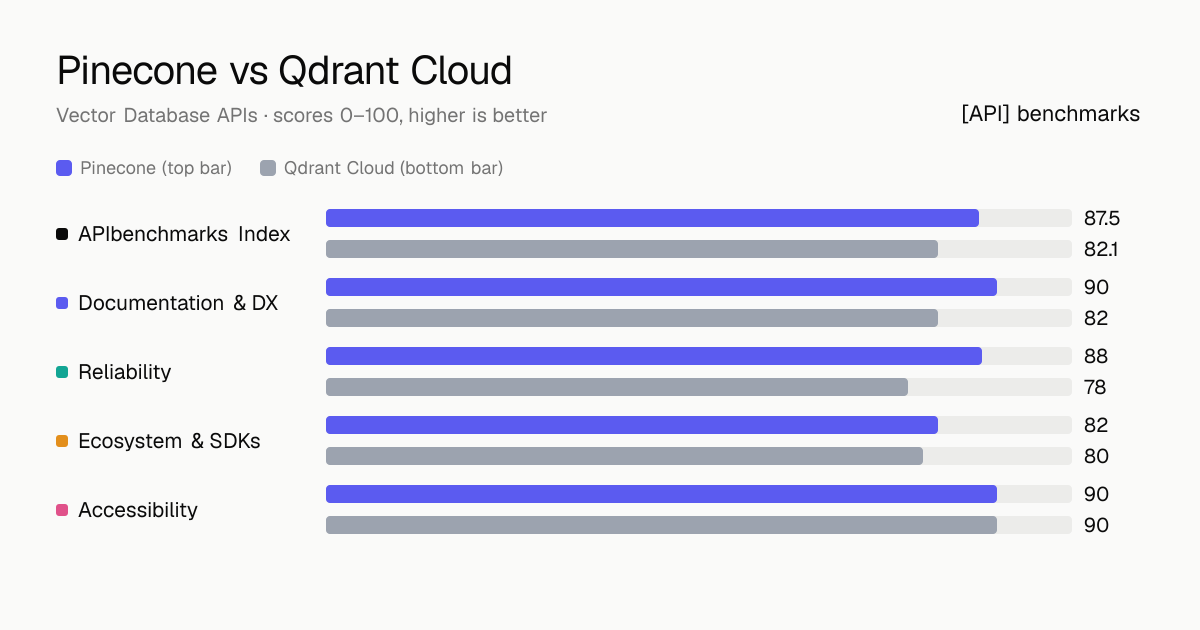
As a vector database API, Pinecone rates higher on the APIbenchmarks Index, 87.5 to 82.1, a 5.4-point gap. Here is how they compare on each criterion.
Criterion by criterion
| Criterion | Pinecone | Qdrant Cloud |
|---|---|---|
| Documentation & DX | ||
| Reliability | ||
| Ecosystem & SDKs | ||
| Accessibility | ||
| APIbenchmarks Index | 87.5 | 82.1 |
Specifications
| Pinecone | Qdrant Cloud | |
|---|---|---|
| Best for | Serverless vector search for production RAG | High-performance open-source vector engine |
| Free tier | Starter: 2GB storage (~350K vectors), 1 index, no SLA | 1GB RAM / 4GB disk cluster (~1M vectors), no card |
| Pricing | Per read/write unit + storage | Resource-based (vCPU/RAM/disk) |
| Official SDKs | 7 languages | 8 languages |
Is Pinecone better than Qdrant Cloud?
On the APIbenchmarks Index, Pinecone rates higher (87.5 vs 82.1). It leads on the four weighted criteria, but price is reported separately, so the best choice still depends on your budget.
Verdict in one line
Pinecone leads by 5.4 points (87.5 vs 82.1) and wins 3 of 4 criteria.
Winner by criterion
| Criterion | Winner | ||
|---|---|---|---|
| Documentation & DX | 90 | 82 | |
| Reliability | 88 | 78 | |
| Ecosystem & SDKs | 82 | 80 | |
| Accessibility | 90 | 90 | Tie |
Choose Pinecone if… / choose Qdrant Cloud if…
- →documentation & dx matters most to you (90 vs 82)
- →reliability matters most to you (88 vs 78)
- →ecosystem & sdks matters most to you (82 vs 80)
- →your use case matches its focus: serverless vector search for production rag
- →you need broad SDK coverage (8 official SDKs vs 7)
- →your use case matches its focus: high-performance open-source vector engine
Pricing side by side
- Model
- Per read/write unit + storage
- Free tier
- Starter: 2GB storage (~350K vectors), 1 index, no SLA
- Starter$0/month
- Builder$20/month flat
- Standard$50/month minimum usage
- Enterprise$500/month minimum usage
- Bring Your Own Cloud (BYOC)Custom
- Model
- Resource-based (vCPU/RAM/disk)
- Free tier
- 1GB RAM / 4GB disk cluster (~1M vectors), no card
- Free Tier$0 (free forever)
- Standard (Managed Cloud)Usage-based (resource billing for vCPU/RAM/disk)
- PremiumCustom / minimum spend required
- Hybrid CloudCustom (pricing on request)
- Private CloudCustom (pricing on request)
Vendor-published pricing, verified 2026-06-27 (Pinecone) and 2026-06-27 (Qdrant Cloud).
SDK and language coverage
Both · 5
PythonGoJava.NET / C#REST API
Only Pinecone · 2
TypeScript / Node.jsgRPC
Only Qdrant Cloud · 3
JavaScript/TypeScript (@qdrant/js-client-rest)Rust (qdrant-client)gRPC API
Strengths and weaknesses
- +Fully managed serverless architecture eliminates shard/replica/index tuning and ops overhead
- +Low-latency similarity search (sub-10ms p95 on serverless per vendor benchmarks) scaling past 100M+ vectors at 1000+ QPS
- +Clean, consistent SDKs across Python, TypeScript, Go, Java, and .NET with async and gRPC options
- –Consumption-based pricing is hard to predict; multiple reports of bills running 2.5-4x over budget at scale
- –Serverless cold starts add 200-800ms latency on idle indexes and cannot be disabled on that tier
- –Self-hosted alternatives (Qdrant, pgvector, Weaviate) are often dramatically cheaper for steady high-volume workloads
- +Among the fastest open-source vector engines, Rust core delivers highest RPS and lowest latency in benchmarks vs Weaviate, Milvus, Elasticsearch and Redis
- +Predictable resource-based pricing (pay for vCPU/RAM/disk, not per query), which stays flat regardless of search volume
- +Generous always-free 1GB managed tier with no credit card required
- –Weak built-in vector visualization / observability, the most consistently cited limitation across reviews
- –Learning curve is steep for teams new to vector databases
- –Free clusters are terminated after a period of inactivity (e.g., ~a week unused)
Pinecone vs Qdrant Cloud: questions
- Which has better documentation, Pinecone or Qdrant Cloud?
- Pinecone scores higher on documentation and developer experience: 90 vs 82 out of 100.
- Which is more reliable, Pinecone or Qdrant Cloud?
- Pinecone scores higher on reliability: 88 vs 78 out of 100.
- Do Pinecone and Qdrant Cloud have a free tier?
- Pinecone: yes (Starter: 2GB storage (~350K vectors), 1 index, no SLA). Qdrant Cloud: yes (1GB RAM / 4GB disk cluster (~1M vectors), no card).
- How are Pinecone and Qdrant Cloud priced?
- Pinecone: Per read/write unit + storage. Qdrant Cloud: Resource-based (vCPU/RAM/disk).
- Which has more official SDKs?
- Qdrant Cloud lists 8 official SDKs, Pinecone lists 7.