
Head to head
Anon vs Supergood
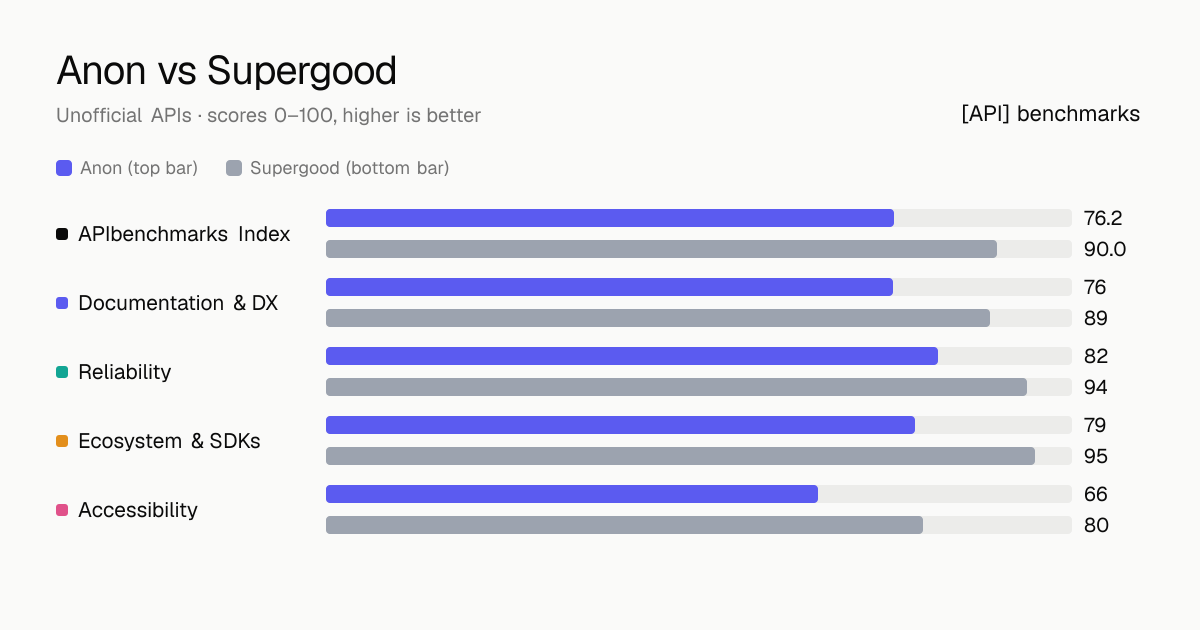
As a unofficial API, Supergood rates higher on the APIbenchmarks Index, 90 to 76.2, a 13.8-point gap. Here is how they compare on each criterion.
Criterion by criterion
| Criterion | Anon | Supergood |
|---|---|---|
| Documentation & DX | ||
| Reliability | ||
| Ecosystem & SDKs | ||
| Accessibility | ||
| APIbenchmarks Index | 76.2 | 90.0 |
Specifications
| Anon | Supergood | |
|---|---|---|
| Best for | Managed authenticated agent workflows | Production APIs for API-less enterprise software |
| Free tier | No | Free to start; 'pay when you close' pilot for deal-blocking integrations |
| Pricing | Sales-led / quoted | Per integration / quoted (no public list price) |
| Official SDKs | 3 languages | 6 languages |
Is Anon better than Supergood?
On the APIbenchmarks Index, Supergood rates higher (90 vs 76.2). It leads on the four weighted criteria, but price is reported separately, so the best choice still depends on your budget.
Verdict in one line
Supergood leads by 13.8 points (90 vs 76.2) and wins 4 of 4 criteria.
Winner by criterion
| Criterion | Winner | ||
|---|---|---|---|
| Documentation & DX | 76 | 89 | |
| Reliability | 82 | 94 | |
| Ecosystem & SDKs | 79 | 95 | |
| Accessibility | 66 | 80 |
Choose Anon if… / choose Supergood if…
- →your use case matches its focus: managed authenticated agent workflows
- →documentation & dx matters most to you (89 vs 76)
- →reliability matters most to you (94 vs 82)
- →ecosystem & sdks matters most to you (95 vs 79)
- →accessibility matters most to you (80 vs 66)
- →you want a free tier to start (Free to start; 'pay when you close' pilot for deal-blocking integrations)
- →you need broad SDK coverage (6 official SDKs vs 3)
- →your use case matches its focus: production apis for api-less enterprise software
Pricing side by side
- Model
- Sales-led / quoted
- Free tier
- No
- EnterpriseQuoted, not publicly listed
- Model
- Per integration / quoted (no public list price)
- Free tier
- Free to start; 'pay when you close' pilot for deal-blocking integrations
- Free start$0
- Pay when you closeDeal-contingent
- Platform / enterpriseQuoted, not publicly listed
Vendor-published pricing, verified 2026-08-12 (Anon) and 2026-08-12 (Supergood).
SDK and language coverage
Both · 0
None
Only Anon · 3
Agent authentication toolkit (developer SDK)Hosted agent runtime APINo-code builder (Anon 2.0)
Only Supergood · 6
REST API (HTTP, primary interface)MCP server (Model Context Protocol)Auto-generated OpenAPI specs per integrationCLIDocumented compatibility: Claude, OpenAI, LangChain, Make, Zapier, ReplitSupergood Workflows agent runtime (~2,000 official APIs via Pipedream)
Strengths and weaknesses
- +Strongest named customer base in the category: Square, Brex, Deel, Personio, Homebase, Middesk, Delphi, MultiOn and 'hundreds more'
- +Self-healing agents designed to recover automatically from UI changes
- +Hosted execution in managed cloud sandboxes; you do not run the browser infrastructure
- –No published pricing, no free tier and no open sandbox; evaluation requires a sales conversation
- –Thin public developer documentation: no quickstart, SDK list or code samples surfaced
- –Execution is fundamentally browser-based, so it mitigates UI drift rather than structurally avoiding it
- +Only vendor in the category that ships generation AND ongoing maintenance as one managed contract, built on its own packet-level observability platform
- +Auto-repair agent detects and fixes vendor-side changes, typically before the customer notices, which is the failure mode that kills DIY reverse-engineering
- +Operates at the API layer, so front-end redesigns do not break the integration the way they break browser automation and scrapers
- –No published list pricing; every engagement is quoted, so budgeting requires a sales conversation
- –No public status page or contractual uptime SLA was found, so reliability claims are vendor-asserted rather than independently verified
- –The headline 4ms / 12ms / 106x performance figures are self-reported and have not been reproduced by a third party
Anon vs Supergood: questions
- Which has better documentation, Anon or Supergood?
- Supergood scores higher on documentation and developer experience: 89 vs 76 out of 100.
- Which is more reliable, Anon or Supergood?
- Supergood scores higher on reliability: 94 vs 82 out of 100.
- Do Anon and Supergood have a free tier?
- Anon: no free tier. Supergood: yes (Free to start; 'pay when you close' pilot for deal-blocking integrations).
- How are Anon and Supergood priced?
- Anon: Sales-led / quoted. Supergood: Per integration / quoted (no public list price).
- Which has more official SDKs?
- Supergood lists 6 official SDKs, Anon lists 3.