
Head to head
Cartesia vs Google Cloud Text-to-Speech
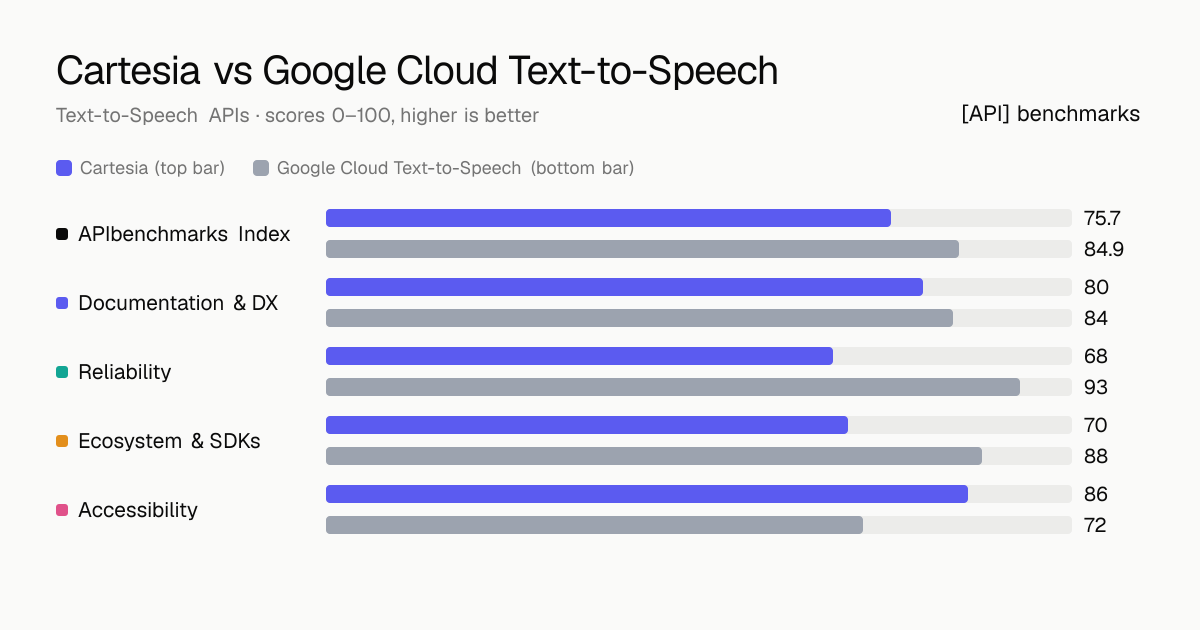
As a text-to-speech API, Google Cloud Text-to-Speech rates higher on the APIbenchmarks Index, 84.9 to 75.7, a 9.2-point gap. Here is how they compare on each criterion.
Criterion by criterion
| Criterion | Cartesia | Google Cloud Text-to-Speech |
|---|---|---|
| Documentation & DX | ||
| Reliability | ||
| Ecosystem & SDKs | ||
| Accessibility | ||
| APIbenchmarks Index | 75.7 | 84.9 |
Specifications
| Cartesia | Google Cloud Text-to-Speech | |
|---|---|---|
| Best for | Real-time TTS for voice agents | Enterprise TTS on Google Cloud |
| Free tier | 20k credits (~15-20 min audio) | 1M (WaveNet) / 4M (Standard) chars/mo |
| Pricing | Per character (credits) | Per 1M characters |
| Official SDKs | 4 languages | 10 languages |
Is Cartesia better than Google Cloud Text-to-Speech?
On the APIbenchmarks Index, Google Cloud Text-to-Speech rates higher (84.9 vs 75.7). It leads on the four weighted criteria, but price is reported separately, so the best choice still depends on your budget.
Verdict in one line
Google Cloud Text-to-Speech leads by 9.2 points (84.9 vs 75.7) and wins 3 of 4 criteria; Cartesia wins 1.
Winner by criterion
| Criterion | Winner | ||
|---|---|---|---|
| Documentation & DX | 80 | 84 | |
| Reliability | 68 | 93 | |
| Ecosystem & SDKs | 70 | 88 | |
| Accessibility | 86 | 72 |
Choose Cartesia if… / choose Google Cloud Text-to-Speech if…
- →accessibility matters most to you (86 vs 72)
- →your use case matches its focus: real-time tts for voice agents
- →documentation & dx matters most to you (84 vs 80)
- →reliability matters most to you (93 vs 68)
- →ecosystem & sdks matters most to you (88 vs 70)
- →you need broad SDK coverage (10 official SDKs vs 4)
- →your use case matches its focus: enterprise tts on google cloud
Pricing side by side
- Model
- Per character (credits)
- Free tier
- 20k credits (~15-20 min audio)
- Free$0/mo
- Pro$5/mo
- Startup$49/mo
- Scale$299/mo
- EnterpriseCustom
- Model
- Per 1M characters
- Free tier
- 1M (WaveNet) / 4M (Standard) chars/mo
- Standard voices$4 / 1M characters
- WaveNet voices$16 / 1M characters
- Neural2 voices$16 / 1M characters
- Studio voices$160 / 1M characters
- Chirp 3: HD voices$30 / 1M characters
- Free tier$0
Vendor-published pricing, verified 2026-06-27 (Cartesia) and 2026-06-27 (Google Cloud Text-to-Speech).
SDK and language coverage
Both · 2
Python (official cartesia-python, PyPI)REST API
Only Cartesia · 2
JavaScript / TypeScript (official client)WebSocket API
Only Google Cloud Text-to-Speech · 8
JavaNode.jsGoRubyC#/.NETPHPC++gRPC API
Strengths and weaknesses
- +Class-leading latency for real-time voice, advertised ~40ms TTFB and measured fastest-tier P50 TTFA vs ElevenLabs and Deepgram in independent benchmarks
- +State-space-model architecture purpose-built for streaming, low-latency conversational audio rather than batch generation
- +Instant voice cloning from as little as 3-10 seconds of audio, plus higher-fidelity professional cloning
- –A developer API, not a business tool, no no-code workflow, helpdesk wiring, or agent-testing layer; you must build the surrounding system
- –Self-reported and reviewer-noted weakness in logging, observability, and troubleshooting tooling
- –Latency consistency is a concern: third-party tests show a wide inter-quartile range, so tail latency can approach the 300ms conversational threshold
- +380+ voices across 75+ languages and variants, one of the widest catalogs available
- +Generous recurring free tier (4M chars/month Standard, 1M WaveNet/Neural2) makes prototyping essentially free
- +99.9% uptime SLA on Google's global infrastructure with financial-credit backing
- –Non-Chirp voices can sound robotic in long-form narration and lower-resource languages
- –Emotional/style expressiveness lags specialist rivals like ElevenLabs
- –Requires coding plus GCP project/credential setup, not friendly to non-developers
Cartesia vs Google Cloud Text-to-Speech: questions
- Which has better documentation, Cartesia or Google Cloud Text-to-Speech?
- Google Cloud Text-to-Speech scores higher on documentation and developer experience: 84 vs 80 out of 100.
- Which is more reliable, Cartesia or Google Cloud Text-to-Speech?
- Google Cloud Text-to-Speech scores higher on reliability: 93 vs 68 out of 100.
- Do Cartesia and Google Cloud Text-to-Speech have a free tier?
- Cartesia: yes (20k credits (~15-20 min audio)). Google Cloud Text-to-Speech: yes (1M (WaveNet) / 4M (Standard) chars/mo).
- How are Cartesia and Google Cloud Text-to-Speech priced?
- Cartesia: Per character (credits). Google Cloud Text-to-Speech: Per 1M characters.
- Which has more official SDKs?
- Google Cloud Text-to-Speech lists 10 official SDKs, Cartesia lists 4.