
Head to head
Mailgun vs SparkPost
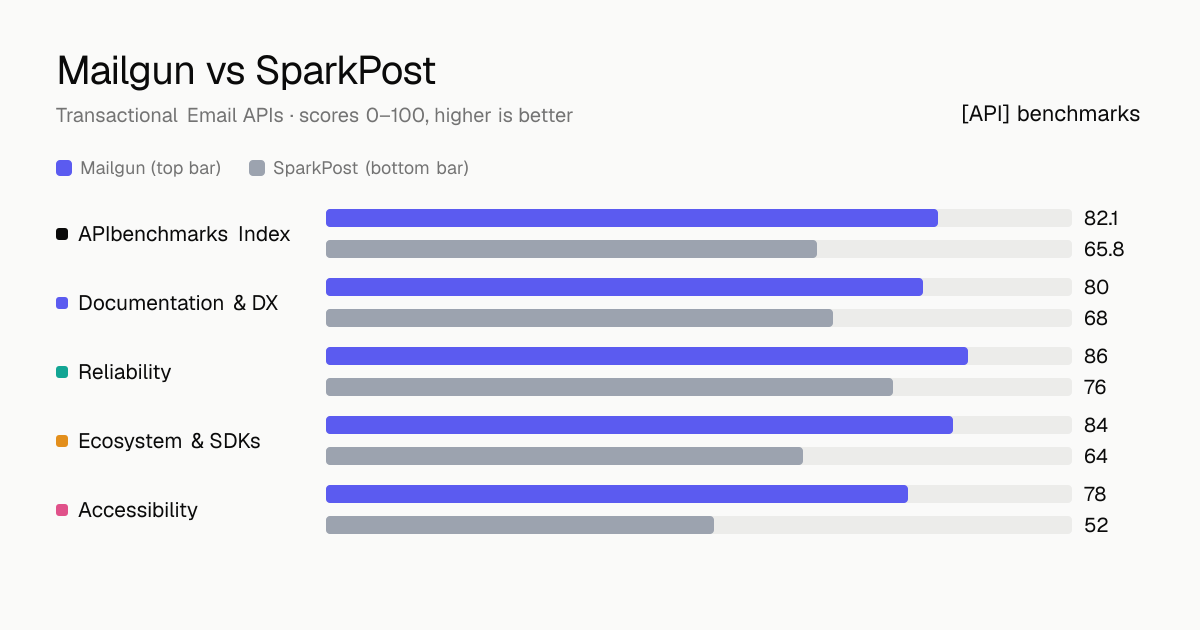
As a transactional email API, Mailgun rates higher on the APIbenchmarks Index, 82.1 to 65.8, a 16.3-point gap. Here is how they compare on each criterion.
Criterion by criterion
| Criterion | Mailgun | SparkPost |
|---|---|---|
| Documentation & DX | ||
| Reliability | ||
| Ecosystem & SDKs | ||
| Accessibility | ||
| APIbenchmarks Index | 82.1 | 65.8 |
Specifications
| Mailgun | SparkPost | |
|---|---|---|
| Best for | Developer email infrastructure at scale | Enterprise high-volume sending via Bird |
| Free tier | 100 emails/day (forever) | ~500 emails/mo (dev tier) |
| Pricing | Per monthly email volume | Volume tiers / custom enterprise |
| Official SDKs | 9 languages | 7 languages |
Is Mailgun better than SparkPost?
On the APIbenchmarks Index, Mailgun rates higher (82.1 vs 65.8). It leads on the four weighted criteria, but price is reported separately, so the best choice still depends on your budget.
Verdict in one line
Mailgun leads by 16.3 points (82.1 vs 65.8) and wins 4 of 4 criteria.
Winner by criterion
| Criterion | Winner | ||
|---|---|---|---|
| Documentation & DX | 80 | 68 | |
| Reliability | 86 | 76 | |
| Ecosystem & SDKs | 84 | 64 | |
| Accessibility | 78 | 52 |
Choose Mailgun if… / choose SparkPost if…
- →documentation & dx matters most to you (80 vs 68)
- →reliability matters most to you (86 vs 76)
- →ecosystem & sdks matters most to you (84 vs 64)
- →accessibility matters most to you (78 vs 52)
- →you need broad SDK coverage (9 official SDKs vs 7)
- →your use case matches its focus: developer email infrastructure at scale
- →your use case matches its focus: enterprise high-volume sending via bird
Pricing side by side
- Model
- Per monthly email volume
- Free tier
- 100 emails/day (forever)
- Free$0/mo
- Basicfrom $15/mo
- Foundation$35/mo
- Scale$90/mo
- EnterpriseCustom (contact sales)
- Model
- Volume tiers / custom enterprise
- Free tier
- ~500 emails/mo (dev tier)
- Starter$20/month
- Premier$75/month
- EnterpriseCustom
Vendor-published pricing, verified 2026-06-27 (Mailgun) and 2026-06-27 (SparkPost).
SDK and language coverage
Both · 6
PythonPHPJavaNode.jsGoSMTP relay
Only Mailgun · 3
RubyC#/.NETREST API
Only SparkPost · 1
Elixir
Strengths and weaknesses
- +Clean, well-documented REST API plus SMTP relay; reviewers report integration in minutes
- +Seven official, actively maintained SDKs (Python, Ruby, PHP, Java, C#, Node.js, Go)
- +Contractual 99.99% uptime SLA on core API/SMTP/outbound delivery for all plan tiers
- –Pricing escalates steeply with volume; reviewers say it has gotten 'pricier and pricier'
- –Legacy pay-as-you-go Flex plan doubled to $2.00/1K in Dec 2025 and is closed to new users
- –Recurring abrupt account suspensions, sometimes right after signup or mid-integration, with no clear reason
- +Strong, industry-respected deliverability via the Adaptive Email Network with real-time adaptive delivery and automated IP warmup
- +Built for very high volume/scale (customers collectively send ~20B+ emails per month)
- +Mature REST API plus SMTP relay, with official SDKs for Node, Python, PHP, Go, and Java
- –Generous free tier (formerly 100k emails/month) has been discontinued; paid plans now start at $20/month
- –Acquisition by MessageBird/Bird has folded the product into a larger CRM platform, creating branding/strategy uncertainty (some sites mark it 'discontinued')
- –Recurring reports of abrupt account suspensions, sometimes without clear explanation
Mailgun vs SparkPost: questions
- Which has better documentation, Mailgun or SparkPost?
- Mailgun scores higher on documentation and developer experience: 80 vs 68 out of 100.
- Which is more reliable, Mailgun or SparkPost?
- Mailgun scores higher on reliability: 86 vs 76 out of 100.
- Do Mailgun and SparkPost have a free tier?
- Mailgun: yes (100 emails/day (forever)). SparkPost: yes (~500 emails/mo (dev tier)).
- How are Mailgun and SparkPost priced?
- Mailgun: Per monthly email volume. SparkPost: Volume tiers / custom enterprise.
- Which has more official SDKs?
- Mailgun lists 9 official SDKs, SparkPost lists 7.